
Refrigerants run at different pressures because each one is a different molecule, and different molecules hold onto each other with different strength. A refrigerant whose molecules are loosely attached escapes into vapor easily. It pushes hard against the walls of whatever holds it, so it has a high pressure at any given temperature. A refrigerant whose molecules cling together more tightly produces a lower pressure at that same temperature. Air conditioning works through boiling and condensing, and boiling happens at a specific pressure for a specific temperature. So every refrigerant comes with its own fixed pressure-temperature relationship.
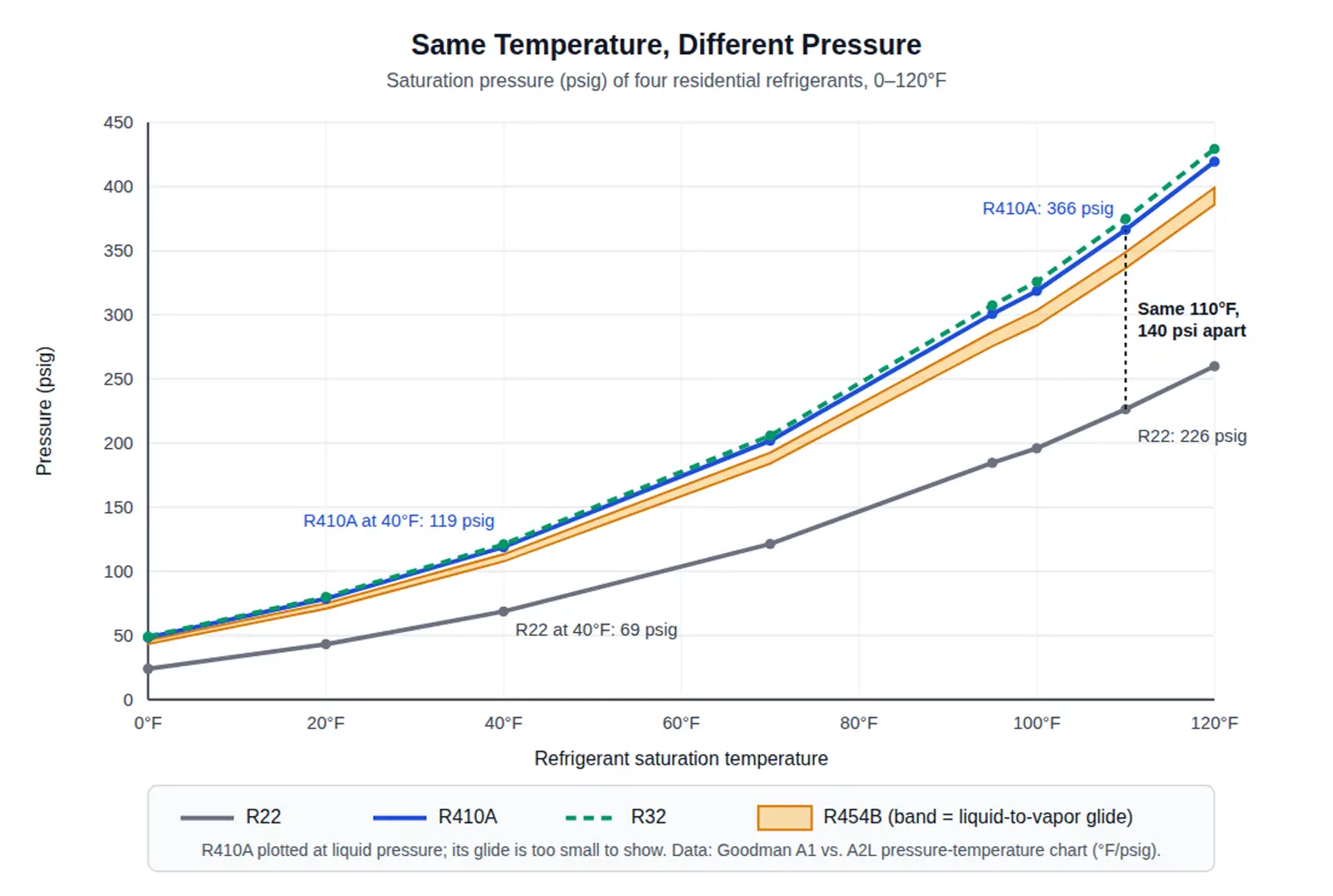
The numbers show how large the difference is. Hold four common residential refrigerants at a 40°F boiling temperature, which is roughly what an indoor coil runs at. R22 sits near 69 psig, R454B near 113, R410A near 119, and R32 near 121. They are doing the same job at the same temperature, and the pressures differ by about 50 psi. At the temperatures an outdoor coil sees on a hot afternoon, R410A runs roughly 140 psi higher than R22.
For a homeowner, the practical point is that you cannot judge a pressure reading unless you know which refrigerant is in the system. A reading that is healthy for one refrigerant would mean a serious problem for another. The pressure design is also built into the equipment itself. Wall thickness, valves, compressor, and oil are all matched to one refrigerant. That is why refrigerants are never mixed or swapped and why a technician's first question is what your nameplate says. The rest of this article covers where these differences come from, how the four refrigerants you are likely to meet compare, what blends and "glide" add, and why a pressure reading on its own can't tell anyone how much refrigerant is in your system.
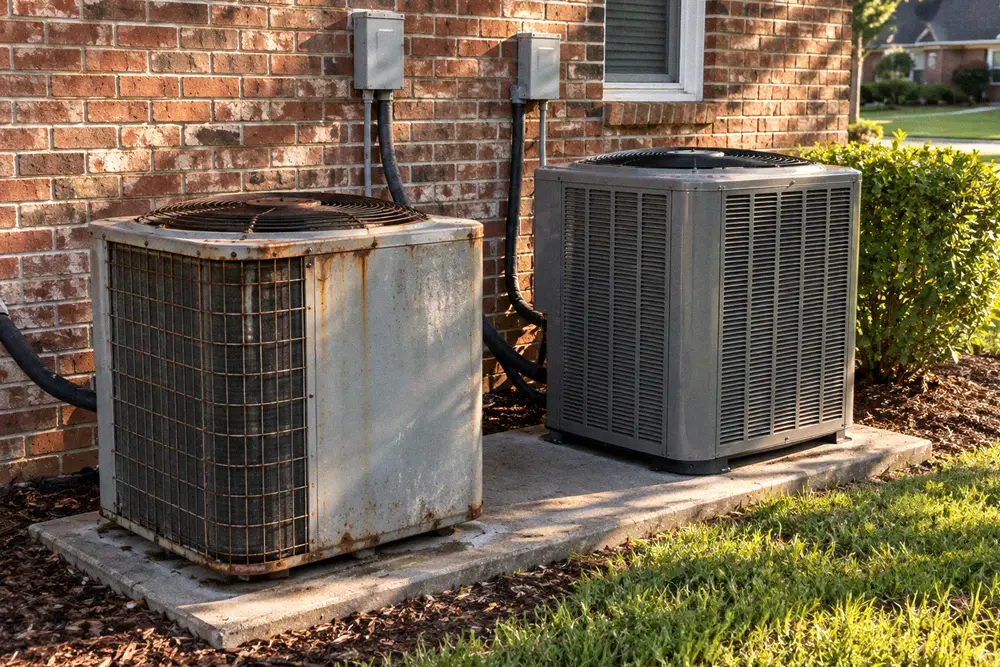
What "Pressure Characteristics" Actually Means
When technicians say a refrigerant has certain pressure characteristics, they mean one specific thing: the pressure the refrigerant settles at when liquid and vapor exist together at a given temperature. That condition is called saturation. You find it inside an indoor coil while refrigerant is boiling, inside an outdoor coil while it is condensing, and inside any cylinder or idle system that still holds some liquid.
At saturation, pressure and temperature are locked together. ACHR News makes the point in its overview of refrigerant pressures, states, and conditions: a refrigerant has a pressure-temperature relationship only at saturation, and as pressure rises, saturation temperature rises with it. If you know one, you know the other. This is what a pressure-temperature chart (a PT chart) records, and each refrigerant has its own.
Outside of saturation the lock releases. Vapor that has boiled completely and kept warming, like the gas in the suction line returning to your outdoor unit, can be at many temperatures for the same pressure. The same is true of liquid cooled below its condensing point. The PT relationship holds only where liquid and vapor coexist. Technicians use that fact deliberately, as later sections show.
So "different pressure characteristics" really means different PT curves. Every refrigerant's curve rises as temperature rises, but each sits at its own height and climbs at its own steepness. The height and steepness come from the molecule.
Why Do Refrigerants at the Same Temperature Have Different Pressures?
The question appears almost word for word on one of the most-searched threads on this topic: why do refrigerants of the same quantity, at the same ambient temperature, show very different pressures? It has two parts, and quantity is the part people find most surprising.
Start with what makes pressure. In a closed container with some liquid in it, molecules at the liquid's surface keep escaping into the space above and keep landing back. They settle into a balance, and the pressure the escaped vapor exerts at that balance is the vapor pressure. Chemistry LibreTexts' chapter on vapor pressure states the key rule. Equilibrium vapor pressure is a characteristic of the material at a given temperature, and it does not depend on how much liquid is present, as long as some liquid remains. The same source explains the other half. Substances whose molecules attract each other weakly are volatile, with high vapor pressures and low boiling points. Substances with strong molecular attraction do the opposite.
That is the whole answer. The pressure a refrigerant produces at 40°F is set by how easily its molecules break away from the liquid at 40°F. Quantity has nothing to do with it. A pound of R410A and a hundred pounds of R410A at the same temperature show the same pressure. R410A's molecules escape their liquid more easily than R22's do, so R410A shows a higher pressure at every temperature.
What makes one molecule escape more easily than another? Two broad factors matter. The first is size and mass: lighter molecules generally need less energy to break free. The second is how strongly the molecules pull on each other, which depends on their shape and how electrical charge is spread across them. Chlorine atoms in R22 make it heavier than the chlorine-free refrigerants that replaced it. R32, the smallest of the common modern refrigerants, is among the most volatile. Mass alone does not settle it, though. As the comparison table below shows, R454B is lighter than R410A but still runs at slightly lower pressure. The overall molecular makeup decides the result, and for blends so does the mix of ingredients.
Why a Refrigerant's Boiling Point Has to Be So Low
A related question comes up on pages about refrigerant boiling points: why does a refrigerant's boiling point have to be so low? The answer explains why every residential refrigerant is extremely volatile compared with anything else in your house.
A substance's normal boiling point is the temperature at which it boils at exactly one atmosphere of pressure (the LibreTexts chapter defines it the same way). Water's is 212°F. The refrigerants in American homes boil somewhere between about -40°F and -61°F at atmospheric pressure. At room temperature and open air, they cannot stay liquid.
That is intentional. An indoor coil has to boil refrigerant at temperatures around 40°F while keeping the refrigerant above atmospheric pressure. If the low side dropped below atmospheric pressure, any small leak would pull air and moisture into the system instead of pushing refrigerant out. A fluid with a very low normal boiling point satisfies both conditions. It boils at useful coil temperatures while still under positive pressure. The trade-off comes on the high side. A fluid that volatile needs much more pressure to condense at outdoor summer temperatures. Every refrigerant choice balances those two ends.
This also explains why pressure differences grow as temperatures rise. PT curves are not parallel lines. The more volatile refrigerants climb more steeply, so a gap of about 50 psi at indoor-coil temperatures widens to more than 100 psi at outdoor-coil temperatures. The chart further down shows it clearly.
The Four Refrigerants in American Homes, Side by Side
Residential U.S. systems use mainly four refrigerants. R22 is found in older equipment. R410A was the standard for the last two decades. R454B and R32 appear in newer equipment built around lower-global-warming refrigerants, and the EPA lists both as acceptable, subject to use conditions, for new residential and light commercial air conditioning and heat pumps. The table compares the physical properties that drive their pressures.
| Refrigerant | What it is | Molecular weight (g/mol) | Boils at 1 atm |
|---|---|---|---|
| R22 | Single compound (HCFC); contains chlorine | 86.47 | -41.4°F |
| R410A | Blend of R32 and R125 (HFC) | 72.58 | -60.8°F |
| R32 | Single compound (HFC); smallest molecule of the four | 52.02 | About -61°F |
| R454B | Blend: 68.9% R32, 31.1% R1234yf | 62.6 | -58.9°F |
Sources: Arkema Forane 22 basic properties; Chemours Freon 410A thermodynamic properties; NIST Chemistry WebBook, difluoromethane (normal boiling point reported near 221.5 K); Chemours Opteon XL41 product information.
Read the boiling-point column first. R22 boils about 20 degrees warmer than the other three, and that one gap accounts for most of the pressure difference between old and new systems. R410A, R32, and R454B fall within a couple of degrees of each other, which is why their pressures are close and R22's is far below them.
Blends need one more note. R410A contains R32 as half its makeup. R454B is mostly R32 with R1234yf, a lower-pressure ingredient, blended in. The ingredients set where each blend falls: R454B runs a little below R410A, and pure R32 runs a little above it.
What the Difference Looks Like at Real Operating Temperatures
Properties at atmospheric pressure explain the cause. What a technician actually sees on the gauges are pressures at operating temperatures. The figures below come from Goodman's A1 vs. A2L pressure-temperature chart, a manufacturer reference that lists all four refrigerants on one sheet in °F and psig.
| Saturation temperature | R22 (psig) | R410A (psig, liquid) | R32 (psig) | R454B (psig, liquid / vapor) |
|---|---|---|---|---|
| 40°F — typical indoor-coil range | 68.6 | 118.8 | 121.0 | 113.3 / 107.7 |
| 70°F — idle system in a mild room | 121.4 | 201.8 | 205.8 | 192.5 / 184.0 |
| 95°F — idle unit on a hot day | 184.6 | 300.7 | 307.4 | 286.6 / 275.4 |
| 110°F — outdoor coil condensing | 226.4 | 366.4 | 374.9 | 348.9 / 336.4 |
| 120°F — outdoor coil on a very hot day | 260.0 | 419.4 | 429.3 | 399.1 / 385.8 |
Source: Goodman A1 vs. A2L Pressure Temperature Chart (°F/psig). Rows labeled "idle" show the pressure an off, equalized system settles to at that temperature. Operating targets for any specific system come from its manufacturer's documentation.
Three patterns stand out. R410A runs about 1.7 times R22's pressure at indoor-coil temperatures and about 1.6 times at outdoor-coil temperatures. R32 tracks R410A within a few psi. R454B runs a little lower than both and lists two numbers per temperature, which the section on glide explains.
Why R410A Runs So Much Higher Than R22
The R22-to-R410A changeover is the pressure difference homeowners run into most, because many houses still have one system of each age, or have replaced one with the other. The size of the jump shapes everything about how the two are serviced.
Chemours' product literature for Freon 410A lists R410A's discharge pressure as 50 to 70% higher than R22's. It also states that R410A cannot be used for retrofit, is meant only for new equipment specifically designed for it, and that most system components were redesigned with thicker walls. The boiling-point gap in the first table is the cause. With a normal boiling point about 20 degrees colder, R410A needs substantially more pressure to reach any given condensing temperature.
Several practical consequences follow for a homeowner. The two generations of equipment are not interchangeable in either direction. Their compressors, coils, valves, and line sets are rated for different pressure ranges. They also use different compressor oils, which is a separate compatibility problem from pressure. A technician's gauges and hoses have to be suitable for the higher-pressure refrigerant. When an older R22 condenser fails, the usual choices are to repair it with R22 or to replace the system. Refilling it with R410A is not one of them. For a date-by-date account of when each refrigerant entered and left new residential equipment, see the residential air conditioner refrigerant timeline.
Higher pressure also affects the outdoor unit you can hear and feel. The refrigerant reaches the same condensing temperature, so the air off the top of the condenser is not hotter because of R410A. The mechanical load is higher, though, and a dirty coil or blocked airflow pushes those pressures up faster. If your outdoor unit's heat worries you, why your outdoor unit feels extremely hot explains what is normal and what is not.
Blends, Glide, and Why a Gauge Can Show Two Pressures
Look again at the R454B column: 113.3 and 107.7 psig at the same 40°F. That split happens because R454B is a blend whose ingredients do not boil at exactly the same temperature. The trade calls it temperature glide.
A single-compound refrigerant like R22 or R32 boils at one temperature for one pressure. A blend's lighter, more volatile ingredient tends to boil off first, so boiling starts at one temperature (the bubble point) and finishes at a slightly higher one (the dew point) at the same pressure. PT charts for blends therefore list a liquid value and a vapor value. For R454B the spread is small. Chemours' Opteon XL41 bulletin on properties, uses, storage, and handling gives an evaporator glide of about 2.0°F for R454B, compared with about 0.2°F for R410A. That is why R410A is described as near-azeotropic, meaning it behaves almost like a single fluid.
Glide changes how the refrigerant must be handled:
- Charging is done as liquid. The same Chemours bulletin tells technicians to remove liquid from the cylinder when charging a blend. Taking vapor off the top would draw the more volatile ingredient first and leave the mix off-spec.
- The math uses the right column. Superheat, the number of degrees suction vapor has warmed above its boiling point, is figured from the dew (vapor) value. Subcooling, the degrees liquid has cooled below its condensing point, is figured from the bubble (liquid) value. Using the wrong column on a blend throws both numbers off by the glide.
- Leaks can shift composition in higher-glide blends. A refrigerant with meaningful glide can lose ingredients unevenly through a leak. This is one reason a leaking system should be repaired and properly recharged rather than topped off again and again.
For a homeowner, the takeaway is that a technician working on a newer blend system should be reading a chart for that exact refrigerant and should know which column applies. It is a fair question to ask.
Is a Higher-Pressure Refrigerant Colder or Better?
One ranking comparison page asks this directly: "Is Puron (R410A) colder than Freon (R22)?" No. Higher pressure does not mean colder air, and it does not mean a better refrigerant.
Every residential system is engineered to boil its refrigerant in the indoor coil at a similar temperature, because the coil temperature is what cools and dries your air. An R22 system and an R410A system can both run their indoor coil near 40°F. The R410A system simply needs about 119 psig to do it, while the R22 system needs about 69. The air at your register comes from coil temperature and airflow, not from the pressure behind them.
What higher pressure does change is how much heat a given volume of refrigerant vapor can carry. Vapor at higher pressure is denser, so each stroke or rotation of the compressor moves more refrigerant mass and therefore more heat. Designers can take advantage of that with compact compressors and coils. The benefit comes with stronger components, different oils, and tighter service practice, and it has to be designed in from the start. Pressure is an engineering parameter, not a performance rating.
The same logic applies among the modern refrigerants. Chemours rates R454B's capacity at about 0.97 of R410A's in air conditioning, while its discharge pressure is somewhat lower (355 psia versus 381 psia in the bulletin's comparison). A modest difference in pressure produced only a small difference in capacity, which is why the industry could design around R454B without starting from scratch. Even so, the bulletin states plainly that because of their flammability rating these refrigerants are intended for equipment specifically designed for them.
What Happens If You Put the Wrong Refrigerant in a System?
This question shows up in search results in both directions, including "Can I use R22 in a R410A system?" and "What happens if you put R410A in an R22 system?" The answer is the same for any mismatch. The system's pressure design, oil, metering device, and safety rating all belong to one refrigerant, and a different refrigerant violates every one of them.
Put R410A into an R22 system and you are running pressures roughly 60 to 70% above what its components were built for, using an oil pairing the manufacturer never specified. Put R22 into an R410A system and pressures fall far below the design point. The metering device (the valve or fixed restriction that feeds liquid into the indoor coil) is sized for the wrong fluid, the charge weight is wrong, and you have added an ozone-depleting refrigerant to equipment that was never certified for it. Either way the likely results are poor cooling, stressed or failed compressors, contaminated oil, and a system no technician can accurately diagnose afterward, because gauge readings no longer match any published chart.
Mixing is worse still. Topping off one refrigerant with another creates a mixture with no published PT chart. Nobody can confirm a proper charge, and the refrigerant can't be reclaimed as either original product. Moving between A1 refrigerants (R22, R410A) and A2L refrigerants (R32, R454B) adds a safety problem. ASHRAE's refrigerant safety classification fact sheet explains that the "2L" rating means lower flammability, and A2L equipment is designed with that in mind. An A1 system is not.
Changing to a different refrigerant is therefore a system-level decision made by a certified technician. It usually means new equipment, and at minimum it means following the manufacturer's documented procedures for that specific pairing. It is never a matter of which cylinder happens to be on the truck.
Why Pressure Can't Tell You How Much Refrigerant Is in There
Here is the misunderstanding homeowners most often act on. If a system's pressure is set by temperature rather than quantity, then a pressure reading on an idle system says almost nothing about whether the charge is correct.
The chemistry rule from earlier applies directly. As long as some liquid remains, a closed container of refrigerant sits at the saturation pressure for its temperature, whether it holds a full charge or a fraction of one. An R410A system sitting idle on a 70°F morning will read about 202 psig when fully charged. It will read about the same with a significant part of the charge leaked out, as long as liquid remains somewhere in it. The pressure only drops below the PT value once the liquid is gone, and by then the system has lost essentially all of its charge.
That is why technicians do not decide charge from standing pressure (the pressure of an off, equalized system). Charge is judged on a running system, at stable conditions, from superheat and subcooling compared with the manufacturer's targets, and it is weighed in against the nameplate specification whenever the system is recharged. It is also why refrigerant cylinders are weighed rather than read: a nearly empty cylinder at room temperature shows the same pressure as a full one.
Two practical consequences follow for you. First, a "pressure check" on an idle system is not a charge diagnosis. If someone tells you your system is low from a standing reading alone, ask how they measured it. Second, a normal-looking standing pressure does not rule out a leak. Leak searches exist for exactly this reason.
Reading the Numbers When a Technician Hooks Up Gauges
You do not need to read gauges yourself, but knowing what the numbers depend on helps you follow a diagnosis and spot a weak one.
| What you might hear | What it actually depends on | A fair follow-up question |
|---|---|---|
| "Your pressures are high." | The refrigerant type, outdoor temperature, and condenser airflow | High compared with what, for this refrigerant, at today's temperature? |
| "It's reading low, so it needs refrigerant." | Charge, but also airflow, filter condition, and metering-device function | What are the superheat and subcooling, and was airflow checked first? |
| "The pressure looks fine with it off." | Mainly ambient temperature, not charge amount | Can you check the charge with the system running? |
| "Newer systems just run higher." | True between R22 and R410A; R454B runs slightly below R410A | Which refrigerant is on the nameplate, and which chart are you using? |
The pattern is simple. A pressure is meaningful only alongside three other facts: which refrigerant is in the system, what temperature it is saturating at, and what the manufacturer's targets are. A technician who gives you the number plus that context is diagnosing. One who gives you only the number is guessing.
Who Can Buy and Handle These Refrigerants
Pressure differences are one reason refrigerant work is restricted to trained technicians. Federal rules are the other, and they apply to every refrigerant discussed here.
The EPA's refrigerant sales restriction limits who may buy refrigerant. Buyers must be Section 608 certified technicians (for stationary equipment like home air conditioners), Section 609 certified technicians (for motor vehicle air conditioning), or employers of certified technicians who provide written evidence of that employment. The restriction covers ozone-depleting refrigerants such as R22 and their non-ozone-depleting substitutes, including R410A, R32, and R454B. The only consumer exception is small cans of two pounds or less, with unique fittings and self-sealing valves, for DIY use on vehicles. That exception does not apply to home systems.
The safe part for a homeowner is paperwork and observation: know which refrigerant your system uses. It is printed on the data plate of the outdoor unit. If the plate is weathered or missing, the unit's age narrows it down, and recommended refrigerants by air conditioner age maps typical installation years to refrigerant types. With the nameplate refrigerant confirmed, your technician can check current availability and cylinder sizes across all refrigerants carried by Freon Shop before ordering. The purchase and the work stay with the certified professional, and the refrigerant always matches what the equipment was built for.
Frequently Asked Questions
Why do refrigerants of the same quantity at the same temperature have very different pressures?
Pressure at saturation depends on the refrigerant's molecules and the temperature, not the amount. Refrigerants whose molecules escape the liquid more easily have higher vapor pressure at every temperature. That is why R410A reads about 119 psig at 40°F while R22 reads about 69.
Why does R410A run at higher pressure than R22?
R410A boils at about -61°F at atmospheric pressure, compared with about -41°F for R22, so it needs far more pressure to condense at any given temperature. Chemours puts R410A's discharge pressure 50 to 70% above R22's, and equipment built for R410A uses heavier-walled components.
Is R410A colder than R22?
No. Both types of system are designed to run the indoor coil at similar temperatures. R410A simply needs higher pressure to get there. The air at your vents depends on coil temperature and airflow, not on refrigerant pressure.
Does R454B run at the same pressure as R410A?
It runs slightly lower. At 40°F, R454B lists about 113 psig (liquid) against R410A's 119. Chemours describes its pressures as close to R410A's with about 97% of the capacity in air conditioning. Even so, R454B is used only in equipment designed for it, not as a retrofit for R410A systems.
Why does an R454B chart show two pressures for one temperature?
R454B is a blend with a small temperature glide, about 2°F in the evaporator. Its ingredients finish boiling at slightly different temperatures, so charts list a liquid (bubble) and a vapor (dew) pressure. Technicians use the vapor value for superheat and the liquid value for subcooling.
Can a pressure reading tell if my AC is low on refrigerant?
Not from an idle system. While any liquid remains, standing pressure tracks temperature rather than quantity. Charge is judged on a running system using superheat and subcooling against the manufacturer's targets.
Why does my system's pressure go up on hot days?
The outdoor coil has to condense refrigerant at a temperature above the outdoor air, and a higher condensing temperature means a higher saturation pressure. A dirty condenser coil or blocked airflow pushes it higher still.
Can I use R22 in an R410A system, or R410A in an R22 system?
No. The pressure ratings, oils, and metering devices are specific to each refrigerant, and neither is a drop-in for the other. Switching refrigerants is a system-level decision for a certified technician.
What to Take Away
A refrigerant's pressure is its fingerprint. It is set by how readily that particular molecule, or blend of molecules, escapes from liquid into vapor at a given temperature. R22's heavier, chlorine-containing molecule gives it the lowest pressures of the four common residential refrigerants. R410A and R32 sit well above it. R454B's blend lands just under R410A. The amount of refrigerant in the system does not change any of those figures.
With that in mind, most pressure questions become straightforward. Two systems reading very differently may both be healthy if they use different refrigerants. A standing reading can't confirm a proper charge. Refrigerants are never mixed or substituted because each piece of equipment is built for one pressure curve. When you need to understand what is happening inside your own system, ask which refrigerant is on the nameplate, which chart is being used, and what the superheat and subcooling read with the system running.