
By Freon Shop Editorial Team · Last updated September 21, 2026
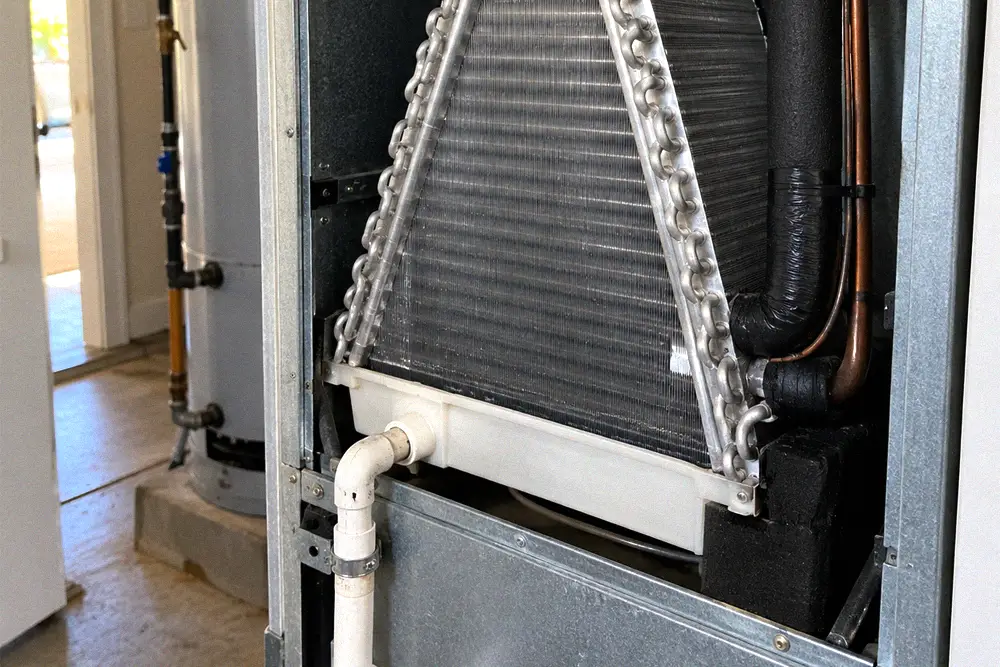
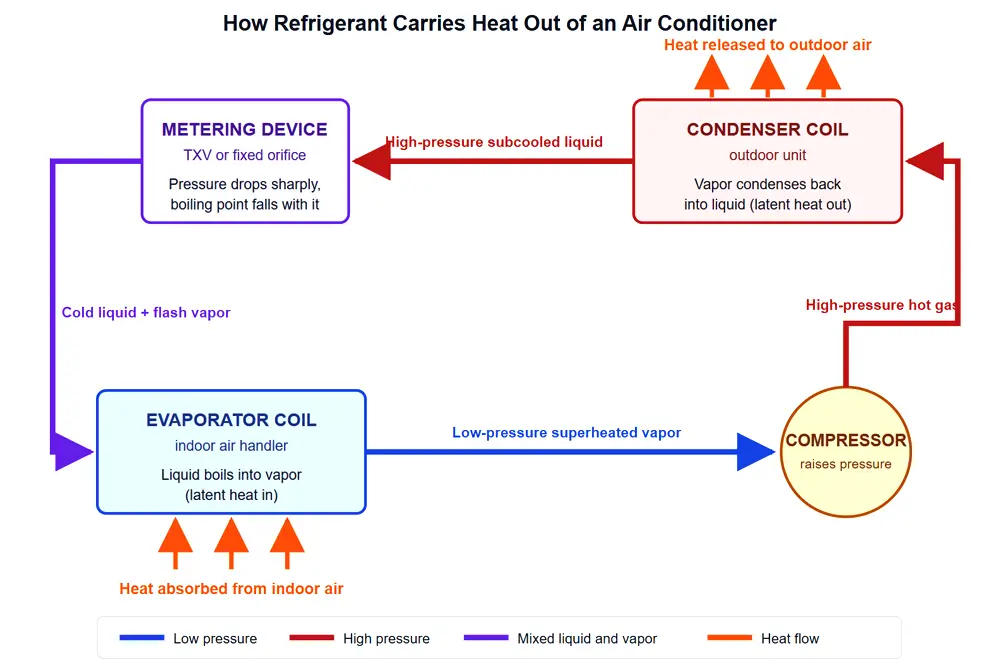
An air conditioner does not manufacture cold. It relocates heat, and refrigerant is the courier. In the coil inside your house, liquid refrigerant boils into vapor under low pressure, and the energy that boiling demands is stripped out of the air blowing across the fins — that is your home's heat leaving the room. Outdoors, after the compressor raises the pressure, the vapor condenses back to liquid and hands that same heat to the air in your yard.
Two consequences follow immediately, and they answer most of what people actually want to know. Refrigerant is not fuel; it is not burned or consumed. It travels a sealed loop and performs the identical job millions of times across the life of the equipment, which means a system that is low on charge has leaked. And refrigerant is not "cold" the way ice is cold. It becomes cold because it is dropped to a pressure at which it cannot remain a liquid, and the violent self-boiling that follows chills whatever liquid is left.
That single mechanism — a fluid swallowing a huge amount of energy when it changes state, at a boiling point you can slide up or down by changing the pressure — is the entirety of air conditioning. Every other component in the cabinet exists to maintain two different pressures in two different places. What follows walks the refrigerant around that loop in the order it travels, translates what a technician is measuring when they say superheat and subcooling, explains what you notice when one link in the chain breaks, and draws an honest line between what you can check yourself and what belongs to a certified technician by law.
Does Refrigerant Get Used Up? No — and That Changes Everything
Settle this first, because it should shape how you read every diagnosis you are ever given.
The refrigerant circuit is sealed. The exact charge weighed in at the factory or at installation is still circulating inside unless something opened a path to the atmosphere. A brazed joint fatigued by vibration, an indoor coil eaten by formicary corrosion, a Schrader valve core weeping past its seal, a flare nut on a mini-split line set that was never torqued properly — those are leaks, and leaking is the only way refrigerant exits a residential system.
So the comparison to topping off a car's air conditioning is misleading. An automotive compressor has a rotating shaft seal engineered to seep slowly over years; a residential split system has no such component and is designed to hold its charge indefinitely. If someone adds refrigerant to your house system this June and you need it again next June, the correct next step is finding the leak, not repeating the top-off. Each repeat costs money, leaves the system running inefficiently in between, and releases refrigerant that federal rules do not permit you to vent. The EPA's page on the prohibition on venting refrigerants allows only minimal releases during good-faith recovery — not routine loss from a leak someone already knows about.
There is one question worth asking at the kitchen table before you approve anything: where is it leaking, and what would repairing that cost against adding refrigerant again next summer? If nobody can answer the first half of that, you are buying a season rather than a repair.
The Four Parts That Move the Heat, and Where They Sit in Your House
A residential split system contains four components in the refrigerant circuit. Each performs exactly one operation on the refrigerant, and you can physically put your hand on three of them.
The evaporator coil lives indoors — an A-shaped or slab coil inside a sheet-metal plenum above, below, or beside your furnace or air handler, or tucked inside the wall-mounted head of a ductless mini-split. Your home's heat enters the refrigerant here.
The compressor is the heavy canister inside the outdoor cabinet, the component responsible for the sound the unit makes on startup. Its only job is raising pressure.
The condenser coil is the fin-wrapped panel forming the outer walls of that same outdoor cabinet. Your home's heat departs here.
The metering device is the one part you will never lay eyes on: a small brass valve or a fixed restriction at the inlet of the indoor coil. "Metering device" is simply the trade's umbrella term for whatever restricts flow and drops pressure at that point. The two common residential types are a thermostatic expansion valve — a TXV, which continuously adjusts itself — and a fixed orifice or capillary tube, which does not adjust at all.
AHRI's homeowner explanation of an air conditioning system lays out the same four parts and the same order of operations: compress, reject heat outdoors, expand, absorb heat indoors. Pull any one of them out and heat stops moving entirely. A compressor with no restriction downstream would merely equalize pressure and spin against nothing. A metering device with no compressor would have no pressure difference to meter. Heat transfer in an air conditioner is never a property of the refrigerant alone — it is a property of the refrigerant plus the pressure architecture assembled around it.
Pressure Sets the Boiling Point, and That Is the Whole Trick
Everything else in this article descends from one physical fact: a refrigerant's boiling temperature is set entirely by the pressure it is held at. Push the pressure up and it boils hotter. Pull the pressure down and it boils colder.
Water makes it intuitive. It boils at 212°F at sea level and measurably cooler in Denver, because there is less atmosphere pressing on the surface. Refrigerants earn their place in HVAC because they land on genuinely useful boiling points at pressures a machine can contain safely.
Consider what a real pressure-temperature chart shows for the refrigerant in most installed U.S. homes. The R410A PT chart published by iGas USA lists roughly 118.8 psig at 40°F, about 366.4 psig at 110°F, and about 419.4 psig at 120°F. Those figures are the reason the machine works at all. At the low pressure your indoor coil operates at, R410A boils cold enough to chill a house. At the high pressure the compressor produces, the identical chemical condenses hot enough to dump that heat into a 95°F backyard.
This relationship is also why a technician can clip gauges onto your system and tell you temperatures nobody measured with a thermometer. If the low-side gauge reads around 119 psig on an R410A system, the refrigerant in the indoor coil is saturating near 40°F. Anywhere refrigerant exists as a liquid-and-vapor mixture, pressure is a direct stand-in for temperature — and that shortcut is the foundation of nearly every charge diagnosis performed in the field.
Inside the Indoor Coil: Where Your House's Heat Enters the Refrigerant
Follow a single pound of refrigerant into the evaporator. It arrives from the metering device cold and at low pressure, mostly liquid with a fraction already vaporized by the pressure drop itself. That mixture is far colder than the return air your blower is pushing across the fins, which in an occupied house is usually somewhere in the mid-70s.
Heat always travels from warm toward cool, so energy leaves the air, crosses the aluminum fins and copper tube wall, and enters the refrigerant. Here is the part that catches people off guard: through most of the coil's length, absorbing all that energy does not raise the refrigerant's temperature by a single degree. It boils more liquid into vapor instead. The refrigerant parks at its saturation temperature — the temperature matching its current pressure — while the incoming energy vanishes into the state change.
The trade calls this latent heat, as distinct from sensible heat, the kind a thermometer actually registers; HVAC School's breakdown of the two latents is a compact primer on the difference. Latent heat is what makes a closet-sized coil capable of cooling a whole house. If the system had to absorb heat merely by warming a circulating liquid, it would need many times the flow to move the same energy — fatter lines, a larger pump, substantially more electricity. Boiling lets a modest mass of refrigerant swallow a large load in a very small heat exchanger.
By the time the refrigerant approaches the coil outlet, effectively all the liquid has boiled off. Only vapor remains, and at that point additional heat finally does raise its temperature. That last stretch of tubing is where superheat lives.
Superheat: The Margin That Keeps Your Compressor Alive
Superheat is how many degrees the vapor has been warmed above its saturation temperature at that pressure. If the low side saturates at 40°F and the vapor leaving the coil reads 50°F, superheat is 10°F.
It is not a comfort figure. It is a proof-of-state figure. Ten degrees of superheat proves that what is leaving the coil is entirely vapor, because any remaining liquid would hold the mixture pinned at saturation temperature and make a higher reading impossible.
That proof matters because compressors are built to pump vapor. Liquid barely compresses at all, and a slug arriving at a running compressor does mechanical damage on the spot. Copeland's training material on causes and prevention of compressor failure treats liquid floodback, and refrigerant diluting the oil protecting the bearings, as leading causes of compressor destruction rather than freak accidents. The compressor is the single most expensive component in the outdoor unit, and superheat is the measurement guarding it.
A TXV exists precisely to hold superheat steady. It senses the suction line leaving the coil and modulates how much liquid it admits. When the load climbs and refrigerant boils off early, superheat rises and the valve opens further. When the load falls and liquid starts reaching the outlet, superheat drops and the valve throttles back. Fixed-orifice equipment has no such feedback loop; it simply holds a set restriction, which is why older fixed-orifice systems are far more sensitive to charge level, a clogged filter, or a brutal afternoon than a TXV system is.
For a homeowner, the translation is short. Superheat running high means the coil is starved — too little refrigerant is arriving, so it finishes boiling early and wastes coil surface. Superheat running low means the coil is flooded and liquid is heading toward the compressor. Neither announces itself immediately as warm air at the register, and both quietly shorten the life of costly parts. That is exactly why a competent service call opens with these numbers instead of with a hose and a cylinder.
The Compressor and Outdoor Coil: Where the Heat Actually Leaves
The compressor pulls in that low-pressure superheated vapor and squeezes it. Raising pressure lifts the saturation temperature with it, and the mechanical work of compression contributes real heat on its own. Vapor leaving a compressor on a July afternoon is genuinely hot — well above outdoor air temperature.
That is the entire objective. Heat only flows from warm to cool. If it is 95°F outside, the refrigerant must be hotter than 95°F before it can give anything away. Compression is what takes a fluid that was absorbing heat at 40°F a few feet earlier and makes it capable of rejecting heat at 110°F or more.
Inside the condenser coil, the evaporator's process runs backward. The first section cools the superheated vapor back down to saturation temperature. Then condensing starts, the temperature stops moving, and a large quantity of latent heat exits the refrigerant into the air stream the outdoor fan is drawing across the fins. The volume collapse is dramatic — vapor becoming liquid occupies a small fraction of the space. By the lower passes of the coil the tube holds high-pressure liquid, and the heat your living room was holding sixty seconds ago is rising off the top of the outdoor unit.
This explains something that worries a lot of homeowners. Air blasting out the top of the condenser that feels uncomfortably hot, and a copper line you would not want to grip, are signs of equipment doing its job rather than failing at it. The diagnostic nuances get their own treatment in why your outdoor unit feels extremely hot, but the essential point is that the outdoor unit is where your house's heat is discarded, plus the electricity the compressor spent discarding it.
It also explains why condenser cleanliness matters far more than it looks like it should. That coil sheds heat by conducting into passing air. Cottonwood fluff, grass clippings, dryer lint, or a privacy fence built too close to the cabinet all choke the airflow. Less air means the refrigerant must run hotter to shed the same heat, which means higher pressure, which means the compressor works harder and delivers less cooling. A matted condenser coil is not a cosmetic issue — it is a tax on every hour the system runs, and rinsing it gently is one of the few maintenance jobs genuinely in a homeowner's lane.
Subcooling and the Metering Device: How Warm Liquid Turns Cold
Liquid leaving the condenser is warm — above room temperature, since it just finished condensing at outdoor conditions. A few inches later, on the far side of the metering device, it is cold enough to chill a house. Nothing removed heat from it along the way.
What happened was a pressure drop. Forced through the restriction, the liquid's pressure falls to the evaporator's low side. At that much lower pressure, its boiling point now sits far below its own current temperature — so it is abruptly too hot to remain liquid, and a portion boils instantly. The trade calls that flash gas, and it is not a defect. The energy required to boil that portion has to come from somewhere, and it comes out of the liquid that did not boil, which chills sharply as a result.
Say it plainly, because it is the least intuitive step in the loop: the cold in an air conditioner is manufactured by throttling, not by a refrigerating chemical. The refrigerant holds no coldness of its own. It becomes cold because it is dropped to a pressure where staying liquid is no longer possible. Energy Vanguard's walkthrough of intermediate air conditioning principles reaches the same conclusion from a building-science direction.
Subcooling mirrors superheat: the number of degrees the liquid has been cooled below its saturation temperature at that pressure. If the high side saturates at 110°F and the liquid line reads 100°F, subcooling is 10°F. Its purpose is the same species of proof — confirming that what leaves the condenser is solid liquid with no vapor bubbles riding along. That matters because a metering device is engineered to meter liquid. Let bubbles reach a TXV and the valve passes a compressible mixture instead, the feed to the indoor coil drops, and capacity falls away even when the total charge is perfectly adequate.
On TXV equipment, subcooling is also the most direct charge indicator available, because the TXV independently regulates superheat — meaning superheat readings describe the valve more than they describe the charge. Low subcooling generally points toward undercharge or a restriction upstream; high subcooling points toward overcharge or a restriction holding liquid back. Between the two measurements, a technician can read the refrigerant's condition at two separate points in a sealed system without opening it, which is precisely why you want both numbers spoken aloud before anyone connects a cylinder to your equipment.
Following the Refrigerant All the Way Around
Laying the sequence out in one place makes the state changes easier to hold onto.
| Where it is | Pressure | What the refrigerant is | What is happening to your home's heat |
|---|---|---|---|
| Entering the indoor coil | Low | Cold liquid plus flash vapor | Nothing yet — it was chilled by the pressure drop, not by giving up heat |
| Through the indoor coil | Low | Boiling liquid and vapor | Taken out of room air at constant temperature, as latent heat |
| Leaving the indoor coil | Low | Superheated vapor | A little more taken in; superheat proves no liquid can reach the compressor |
| Out of the compressor | High | Very hot vapor | Still being carried, now hot enough to beat the outdoor air |
| Through the outdoor coil | High | Condensing vapor and liquid | Released into the yard at constant temperature, as latent heat |
| In the liquid line | High | Subcooled liquid | Gone; subcooling proves no vapor bubbles are heading for the valve |
| Through the metering device | High to low | Liquid flashing into a mixture | No heat removed — self-boiling chills the remaining liquid for the next pass |
Heat genuinely enters or leaves the refrigerant at only two stops on that list. Everything else is setup.
The Coil's Second Job: Why It Pulls Water Out of Your Air
Cooling is only half of what the indoor coil delivers. Because the coil surface runs below the dew point of the air moving across it, moisture condenses onto the fins, runs down into the drain pan, and leaves through the condensate line. On a humid day a properly sized residential system removes gallons of water this way, and the comfort improvement from that dehumidification is often larger than the improvement from the temperature drop alone.
This matters for two reasons a homeowner will actually notice. First, condensation only happens if the coil is cold enough and the air lingers long enough. Oversized equipment that satisfies the thermostat in eight-minute bursts cools the air but barely dries it, which is why an oversized system can leave a house at 72°F and still feel clammy. Second, anything that disturbs the refrigerant's heat absorption disturbs moisture removal along with it — which is why humidity complaints and charge problems so often arrive together. We covered that interaction separately in whether a refrigerant leak can affect indoor humidity.
There is also a failure mode here worth recognizing. If airflow across the coil collapses — a filter left in for eight months, a closed-off return, a failing blower — the coil surface drops below freezing, condensate turns to ice, and the ice further blocks airflow. HVAC School's field write-up on the impacts of decreasing evaporator airflow traces that chain in detail. If you find your indoor coil or the copper line at the air handler encased in ice, shut the cooling off and leave the fan running to thaw it before calling anyone; running the compressor against a frozen coil is how liquid reaches it.
What You Notice When Heat Transfer Stops Working
Because each component contributes one specific thing, each failure produces a recognizable pattern. This table is for recognizing what you are looking at, not for repairing it.
| What you observe | Where heat transfer broke down | Common cause |
|---|---|---|
| Air from vents is cool but never cold; runs constantly | Too little refrigerant boiling in the indoor coil | Undercharge from a leak, or a restricted metering device |
| Ice on the indoor coil or the large copper line | Coil surface below freezing, condensate turning to ice | Blocked filter, closed returns, weak blower, or low charge |
| House cools but stays damp and clammy | Coil not running long or cold enough to condense moisture | Oversized equipment, short cycling, or excessive airflow |
| Outdoor unit runs hot and loud, cooling is weak | Heat cannot leave the condenser fast enough | Dirty coil, blocked airflow, failing fan, or overcharge |
| System trips its breaker or shuts down on hot afternoons | High-side pressure climbing past the protection limit | Condenser heat rejection failing under peak load |
| Oily residue or dirt buildup at a fitting or coil bend | Refrigerant escaping the sealed loop | A leak carrying compressor oil out with the refrigerant |
The pattern to internalize: almost every complaint on that list traces back to either not enough refrigerant boiling indoors or not enough heat leaving outdoors. Two of the causes — a filthy filter and a matted condenser — are homeowner-fixable in an afternoon. The rest require gauges on a sealed system.
Can I Add Refrigerant Myself? What the Rules Actually Say
This deserves a direct answer rather than a hedge, because the internet is full of both wishful thinking and vague warnings.
Bulk refrigerant sales in the United States are restricted. The EPA's refrigerant sales restriction permits purchase by Section 608 certified technicians, by Section 609 certified technicians for motor vehicle air conditioning, and by employers of certified technicians who furnish written evidence of that employment. The restriction covers ozone-depleting refrigerants and their non-ozone-depleting substitutes alike, which means the HFC in your house — R410A included — falls under it just as R22 does. The narrow consumer exemption is for small cans of two pounds or less, with unique fittings and self-sealing valves, intended for DIY work on a car's air conditioning. That exemption does not extend to your home system.
Certification itself is not a formality either. EPA's page on Section 608 technician certification states that anyone who maintains, services, repairs, or disposes of equipment that could release refrigerant must pass an EPA-approved test, and that this requirement was extended on January 1, 2018 to appliances using most substitute refrigerants, HFCs among them.
The practical reasons line up with the legal ones. Charging a residential system correctly is not "adding until it feels cold." It means recovering what is in there, finding and repairing the leak, evacuating the system to remove air and moisture, and weighing in the manufacturer's specified charge — then verifying with superheat and subcooling. Guessing instead produces an overcharged system that floods the compressor with liquid or an undercharged one that overheats it, and either outcome costs more than the service call would have. So: check your filter, rinse your condenser, keep shrubs back from the cabinet, note what you observe — and hand the sealed system to someone certified to open it.
Does the Type of Refrigerant Change How the Heat Moves?
The mechanism is identical across every common refrigerant: boil low, condense high, repeat. What changes is the pressure at which that happens, the capacity per pound, the oil the system requires, and the safety classification the equipment is engineered around.
Operating pressure alone settles the question of substitution. R410A runs at substantially higher pressures than R22 at the same temperatures, which is why R410A equipment uses heavier-walled components — and why pouring R410A into a system built for R22 is not a shortcut but a failure waiting to happen. Safety classification matters too. ASHRAE's fact sheet on refrigerant designations and safety classifications explains the A1/A2L system, where the letter reflects toxicity and the number reflects flammability. R22 and R410A are A1. R32 and R454B are A2L — mildly flammable — which drives different equipment design, leak detection, and service procedure.
| Refrigerant | Composition | ASHRAE safety group | Where a homeowner runs into it |
|---|---|---|---|
| R22 | Single-component HCFC | A1 | Older systems still in service, generally installed before the R410A changeover |
| R410A | HFC blend | A1 | The most common refrigerant in installed U.S. residential split systems |
| R32 | Single-component HFC | A2L | Ductless mini-splits and some packaged equipment; also a blend component |
| R454B | HFO/HFC blend | A2L | Newer residential split systems from major U.S. manufacturers |
Safety classifications above follow ASHRAE Standard 34; the current listings are published on the ASHRAE refrigerant designations page.
The practical instruction is simple: the right refrigerant is the one printed on your outdoor unit's data plate, not the one that sounds closest. Read that plate before you or your technician compares anything, since the pressure design, the compressor oil, and often the metering device are matched to that specific fluid. If you are trying to narrow it down from the equipment's age, our guide to recommended refrigerants by air conditioner age gets you close, and once the nameplate model is confirmed you can compare available cylinder sizes across all refrigerants stocked at Freon Shop — with the purchase and handling limits above still applying, since that cylinder is for the certified technician doing the work, not for the homeowner.
One more wrinkle worth knowing if yours is a blend. Zeotropic blends, whose components boil at slightly different temperatures, show temperature glide — the saturation temperature shifts across the coil instead of holding flat. That is why such blends must be charged as liquid from the cylinder, why topping off a leaking blend system can shift its composition, and why superheat and subcooling on a glide refrigerant are figured from dew point and bubble point rather than one saturation number.
What to Ask the Technician Standing in Your Driveway
Understanding the cycle is most valuable at the moment someone hands you a quote. Four questions separate a diagnosis from a guess.
"What are the superheat and subcooling?" These are measured, not estimated, and a technician working properly will have both. Numbers plus an explanation of what they indicate is a real diagnosis; "it's low" by itself is not.
"Where is it leaking?" If the answer involves adding refrigerant without locating a leak, ask what happens next summer. A leak search — electronic detector, bubble solution, UV dye, or a nitrogen pressure test — is billable work, and worth it.
"Did you check airflow before touching the charge?" A plugged filter, a crushed flex duct, or a dying blower motor produces symptoms that mimic low charge. Adding refrigerant to an airflow problem makes things worse, not better.
"What does the data plate say, and what is the factory charge?" Correct charging is weighed against the manufacturer's specification and then verified. If nobody read the plate, nobody knows the target. If you need order or shipping help on a product question while sorting this out, support@freonshop.com is the place to ask.
Frequently Asked Questions
Does refrigerant get used up over time?
No. It circulates in a sealed loop and is not consumed by normal operation. A system that is low has leaked, and the leak is the actual repair.
What happens if my AC is low on refrigerant?
Less refrigerant boils in the indoor coil, so less heat is absorbed per hour. The air feels cool rather than cold, run times stretch out, humidity control suffers, and the coil may freeze. Left alone, low charge can also overheat the compressor.
Why is my AC blowing warm air if it still has refrigerant?
Charge is only one link. A dirty condenser preventing heat from leaving, a failed outdoor fan, a restricted metering device, or a compressor that has stopped pumping will all produce warm air while refrigerant remains in the system.
Is it bad that my outdoor unit blows hot air?
No — that is the heat from inside your home leaving, plus the energy the compressor used moving it. Hot air off the top of the condenser is a sign of normal operation.
Why does my indoor coil freeze up?
The coil surface has fallen below freezing and condensate is icing over. The usual culprits are restricted airflow — a plugged filter, closed returns, a weak blower — or low charge. Turn cooling off and run the fan to thaw it before anyone diagnoses it.
Is R410A interchangeable with R22?
No. R410A operates at substantially higher pressures and uses a different oil, and equipment built for R22 is not designed for either. Replacements and retrofits are system-specific decisions for a certified technician, not a swap.
Can I buy refrigerant for my own home system?
Bulk refrigerant sales are limited to Section 608 and Section 609 certified technicians and to employers of certified technicians who provide written evidence of employment. The small-can exemption applies to automotive air conditioning, not residential systems.
What can I actually do myself?
Replace the filter on schedule, keep supply and return vents open, clear vegetation and debris from around the outdoor unit, rinse the condenser fins gently with a hose, and keep the condensate drain clear. Everything inside the sealed refrigerant circuit belongs to a certified technician.
The One Idea Worth Keeping
If you retain a single sentence from all of this, make it this one: your air conditioner is a heat conveyor, and refrigerant is the belt. It picks heat up indoors by boiling, sets it down outdoors by condensing, and the compressor and metering device simply maintain the two pressures that make both possible at the temperatures your house and your backyard happen to be.
That framing makes the symptoms legible. Weak cooling means the belt is not picking up enough — too little refrigerant boiling indoors, or the air not reaching the coil. A hot, straining outdoor unit means it is not setting enough down. And a system needing refrigerant twice means the belt has a hole in it, which is a repair rather than a refill. Bring those distinctions to the next service call and you will be able to tell a real diagnosis from a guess in about ninety seconds.