
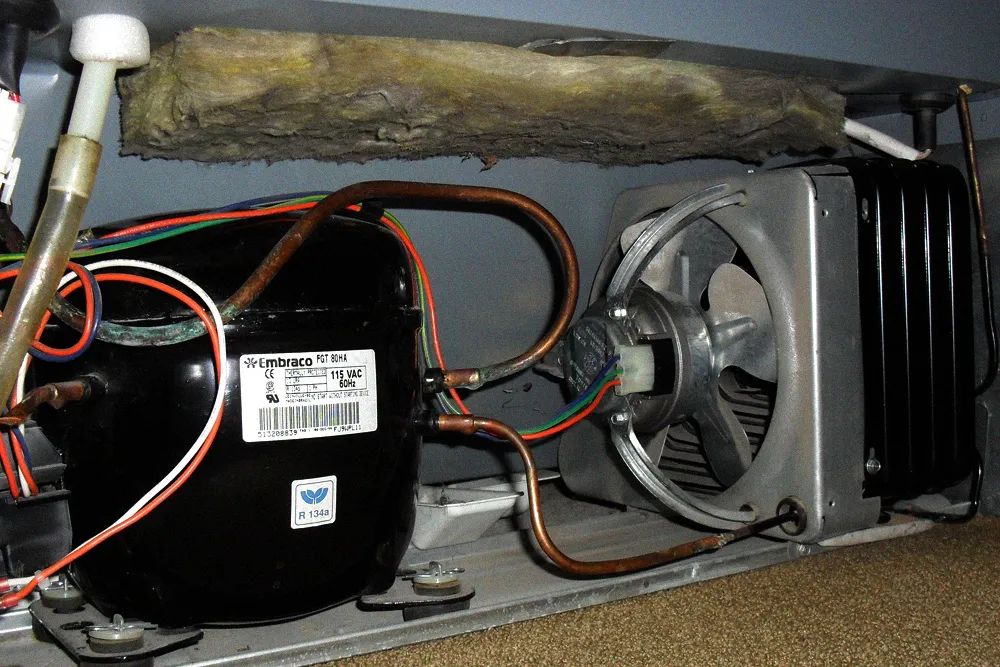
Different air-conditioning systems use different refrigerant pressures because every refrigerant has its own pressure-temperature relationship. At the same saturation temperature, R-22, R-410A, R-32, and R-454B do not produce identical pressures.
The equipment must therefore be engineered around the refrigerant it is designed to use. That includes the compressor, heat exchangers, metering device, tubing, service valves, controls, lubricant, pressure limits, and diagnostic procedures.
A higher-pressure refrigerant is not automatically more powerful, more efficient, or “better.” It simply operates according to different thermodynamic properties in equipment specifically designed for those properties.
Refrigerant Pressure Is Closely Connected to Temperature
Refrigerant pressure cannot be interpreted without temperature.
Inside an operating AC system, refrigerant repeatedly evaporates and condenses. When liquid refrigerant boils in the evaporator, it absorbs heat from the indoor air. When refrigerant vapor condenses in the outdoor coil, it releases that heat.
During these phase changes, pressure corresponds to a saturation temperature. HVAC professionals use a refrigerant-specific pressure-temperature chart, often called a P-T chart, to convert a measured pressure into its corresponding saturation temperature.
For example, approximately 69 psig represents a saturation temperature near 40°F for R-22. That same 40°F saturation temperature corresponds to approximately 119 psig for R-410A.
The temperatures are similar, but the pressures are dramatically different because the refrigerants have different molecular and thermodynamic properties.
The Low Side and High Side of an AC System
A conventional vapor-compression AC system has two primary pressure regions.
Low-pressure side
The low side normally includes the evaporator outlet, suction line, and compressor inlet. Refrigerant enters the evaporator at a reduced pressure, allowing it to boil at a temperature low enough to absorb heat from the indoor air.
The compressor pulls the resulting vapor through the suction line.
High-pressure side
The compressor raises the pressure and temperature of the refrigerant vapor. That hot vapor travels to the condenser, where outdoor air removes heat and the refrigerant condenses into liquid.
The liquid then passes through an expansion valve, piston, capillary tube, or another metering device. The restriction creates a pressure drop before the refrigerant returns to the evaporator.
The compressor creates flow and maintains the pressure difference. The metering device separates the high-pressure and low-pressure sides.
Comparing Refrigerants at the Same Saturation Temperature
The following values illustrate how much pressure can vary between refrigerants even when their saturation temperatures are similar.
| Refrigerant | Approx. Pressure at 40°F Saturation | Approx. Pressure at 100°F Saturation | Important Note |
|---|---|---|---|
| R-22 | 68.6 psig | 195.9 psig | Historically used in many older residential and light-commercial systems. |
| R-410A | 118.8 psig | 318.6 psig | Operates at substantially higher pressure than R-22. |
| R-32 | 121.0 psig | 325.7 psig | A single-component A2L refrigerant used only in equipment designed for it. |
| R-454B | About 110 psig | About 297 psig | A zeotropic A2L blend with separate bubble- and dew-point temperatures. |
Sources: R-22, R-410A, and R-32 figures are from the Arkema Forane pressure-temperature chart. R-454B figures are approximate average saturation values based on the Honeywell Solstice 454B P-T chart.
These are static saturation comparisons for education. They are not universal charging targets or guaranteed operating pressures. Actual system pressures depend on load, airflow, equipment design, outdoor temperature, indoor conditions, compressor operation, and other variables.
Why Equipment Must Be Designed for Its Refrigerant
An AC manufacturer does not select a refrigerant independently of the rest of the system. The entire refrigerant circuit is engineered as a package.
Compressor design
The compressor must provide the required refrigerant mass flow and compression ratio while staying within approved motor-current, discharge-temperature, and pressure limits.
Two refrigerants can produce similar saturation pressures but require different mass-flow rates or compressor characteristics. Pressure similarity alone does not establish compatibility.
Heat-exchanger design
Evaporator and condenser coils are selected according to the refrigerant’s capacity, flow rate, pressure drop, temperature glide, and heat-transfer behavior.
Changing the refrigerant without an engineered retrofit can alter coil performance and oil return.
Tubing and component pressure ratings
Copper tubing, valves, filter driers, hoses, recovery equipment, pressure switches, and service tools must be rated for the system’s expected working pressure.
Tools suitable for an older R-22 system may not automatically be appropriate for a higher-pressure system.
Metering device selection
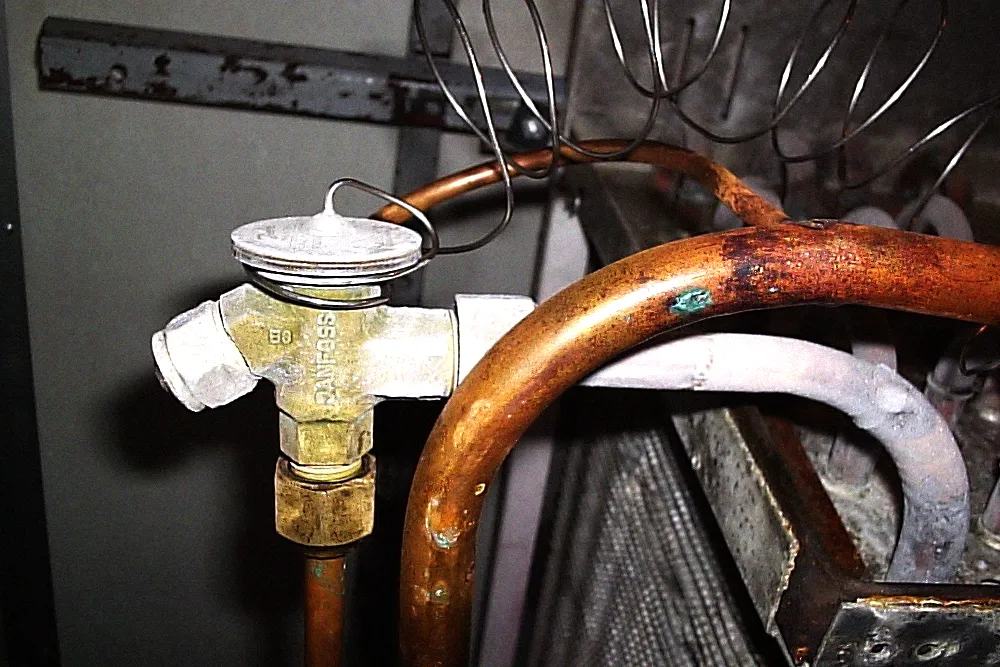
A piston, thermostatic expansion valve, or electronic expansion valve must control the correct amount of refrigerant under changing load conditions.
A device selected for one refrigerant may not deliver the correct mass flow when used with another.
Refrigerant safety characteristics
R-32 and R-454B have an A2L safety classification, indicating lower toxicity and mild flammability. Equipment and service procedures must account for those characteristics.
Chemours describes R-454B as an option for new equipment designs intended to replace R-410A applications—not as a refrigerant that should simply be placed into existing R-410A equipment. Its product information also identifies a temperature glide of approximately 2°F and an A2L classification. Chemours Opteon XL41 product information
There Is No Single “Normal AC Pressure”
Homeowners frequently search for a normal suction or high-side pressure. Unfortunately, no single number applies to every system—or even to the same system under every condition.
Operating pressures can change with:
- Outdoor dry-bulb temperature
- Indoor temperature and humidity
- Cooling load
- Evaporator airflow
- Dirty filters or coils
- Blower and condenser-fan performance
- Compressor condition
- Metering-device operation
- Refrigerant charge
- Line-set length and installation
- Cooling or heating mode
- Variable-speed system capacity
A system operating on a mild morning may show very different readings from the same system running during a hot, humid afternoon.
Pressure readings must be evaluated against the equipment manufacturer’s procedure and the conditions present when the readings were recorded.
Pressure Alone Cannot Confirm Refrigerant Charge
Pressure is an essential diagnostic measurement, but it is only one part of the diagnosis.
A low suction pressure could indicate insufficient refrigerant. It could also result from restricted airflow, a dirty evaporator, a metering-device restriction, low indoor load, or another fault.
High head pressure may be associated with overcharging, but it can also result from a dirty condenser, inadequate outdoor airflow, noncondensable gas, or unusually high ambient temperature.
| Pressure Observation | Possible Causes | What Else Must Be Checked |
|---|---|---|
| Low suction pressure | Low charge, restricted airflow, low load, restricted metering device | Superheat, airflow, coil condition, temperature split and leak evidence |
| High suction pressure | High load, compressor wear, metering-device issue or excess flow | Superheat, compressor performance and indoor conditions |
| High discharge pressure | Dirty condenser, poor airflow, overcharge, noncondensables or high outdoor temperature | Subcooling, condenser airflow and liquid-line temperature |
| Low discharge pressure | Low load, low charge, cool outdoor conditions or weak compressor | Superheat, subcooling, compressor current and system capacity |
Source note: Diagnostic patterns are general examples, not substitutes for the manufacturer’s service data. Multiple faults can create similar pressure readings.
The U.S. Department of Energy’s air-conditioner diagnostic guidance explains that standard charge evaluation uses pressure gauges and temperature sensors to calculate superheat or subcooling. Target measurements should be compared with manufacturer specifications after airflow and testing conditions are considered. DOE Measure Guideline: Air Conditioner Diagnostics
Superheat and Subcooling Add Meaning to Pressure
Pressure becomes much more useful when paired with refrigerant-line temperature.
Superheat
Superheat is the difference between the measured vapor-line temperature and the refrigerant’s saturation temperature at the measured low-side pressure.
It helps a technician determine whether refrigerant leaving the evaporator is fully vaporized and how effectively the evaporator is being fed.
Subcooling
Subcooling is the difference between the refrigerant’s saturation temperature at the measured high-side pressure and the actual liquid-line temperature.
It helps show whether a solid column of liquid is reaching the metering device and is commonly used when evaluating systems equipped with thermostatic expansion valves.
The correct target is equipment-specific. A technician should not assume that one superheat or subcooling value applies to every system.
Bubble Point, Dew Point, and Refrigerant Blends
Some refrigerants are single substances, while others combine two or more refrigerant components.
A zeotropic blend can change temperature as it evaporates or condenses at a constant pressure. This difference is known as temperature glide.
Its P-T data may therefore include:
- Bubble-point temperature: The saturated-liquid value used when calculating subcooling.
- Dew-point temperature: The saturated-vapor value used when calculating superheat.
Arkema’s technical guidance specifies using the vapor or dew value for superheat and the liquid or bubble value for subcooling when a P-T chart supplies two columns. Arkema: Liquid or Vapor Pressure
R-454B, for example, has separate bubble, average, and dew temperatures on Honeywell’s pressure-temperature chart. Selecting the wrong column can introduce an error into a superheat or subcooling calculation.
Static Pressure Is Not the Same as Running Pressure
When the compressor has been off long enough, pressures on the high and low sides tend to equalize. This resting value is often called static pressure.
Static pressure primarily reflects refrigerant temperature and the refrigerant’s P-T relationship. It cannot reliably reveal the complete charge quantity.
If liquid and vapor coexist, a system or cylinder can show approximately the expected saturation pressure while still containing very different amounts of refrigerant. That is why static pressure alone cannot prove that an AC system has the correct charge.
Running pressures provide more information, but they still require temperature, airflow, load, and manufacturer data.
Similar Pressures Do Not Make Refrigerants Interchangeable
R-410A, R-32, and R-454B can have broadly similar pressure ranges under certain conditions. That does not make them interchangeable.
They differ in composition, safety classification, mass flow, lubricant considerations, temperature glide, service procedures, charge limits, and equipment requirements.
Never mix refrigerants or select a substitute based only on a pressure chart. The equipment nameplate, manufacturer documentation, and an approved retrofit procedure—if one exists—must determine the refrigerant.
A Safer Diagnostic Process
An HVAC professional evaluating refrigerant pressure should generally:
- Identify the exact equipment model and nameplate refrigerant.
- Review the manufacturer’s charging and service instructions.
- Confirm that filters, coils, blowers, and fans provide proper airflow.
- Measure indoor and outdoor conditions.
- Use instruments and hoses rated for the refrigerant and expected pressure.
- Convert pressure to saturation temperature using the correct P-T data.
- Calculate superheat and subcooling using the appropriate dew or bubble value.
- Compare the results with manufacturer targets.
- Investigate and repair leaks instead of repeatedly adding refrigerant.
- Recharge only with the exact approved refrigerant and prescribed method.
Under EPA Section 608 rules, technicians who maintain, service, repair, or dispose of equipment in ways that could release regulated refrigerants must have the applicable certification. EPA Section 608 technician certification requirements
Frequently Asked Questions
Why does R-410A operate at a higher pressure than R-22?
R-410A has a different chemical composition and pressure-temperature relationship. At the same saturation temperature, it produces a higher pressure than R-22. R-410A equipment is built with components designed for that pressure range.
Is high refrigerant pressure always caused by overcharging?
No. High pressure may also result from restricted condenser airflow, a dirty condenser coil, high outdoor temperature, noncondensable gas, or another system problem.
Does low suction pressure always mean the system is low on refrigerant?
No. Restricted indoor airflow, an iced or dirty evaporator, low cooling load, or a metering-device restriction can also reduce suction pressure.
Can static pressure show whether an AC system is fully charged?
Not reliably. Static pressure mainly shows the pressure-temperature equilibrium of the refrigerant. It does not reveal the total refrigerant mass with enough certainty to verify charge.
Why do technicians measure both temperature and pressure?
Pressure provides a saturation temperature when converted through the correct P-T chart. Comparing that value with the measured line temperature allows the technician to calculate superheat or subcooling.
Can R-32 or R-454B be placed in an R-410A system?
Not simply because their pressures appear similar. R-32 and R-454B have different properties and A2L safety requirements. They must be used only in approved equipment or under a manufacturer-authorized procedure.
Are refrigerant pressures the same in heating and cooling modes?
No. A heat pump reverses refrigerant flow, and its operating pressures change with mode, indoor conditions, outdoor temperature, defrost operation, and equipment controls.
Final Takeaway
Refrigerant pressure is not an isolated number. It represents the interaction between a particular refrigerant, its temperature, the equipment design, airflow, and the current cooling or heating load.
R-22, R-410A, R-32, and R-454B can operate at very different pressures while performing the same basic job. The correct pressure is therefore the pressure expected for the exact refrigerant, equipment, and test conditions—not a universal value found online.
When purchasing refrigerant, confirm the full refrigerant designation from the equipment nameplate and have system diagnosis and charging performed by an appropriately certified HVAC professional. Freon Shop offers factory-sealed, brand-new refrigerants through its refrigerant collection for customers who have verified the correct product for their equipment.