
Updated September 19, 2026
The United States is phasing down hydrofluorocarbons, or HFCs. This affects familiar refrigerants such as R410A, R404A, and R134a, along with other HFC-containing blends. Importantly, R32 is also a regulated HFC, even though it has a lower global warming potential than many older refrigerants.
However, “being phased down” does not mean a refrigerant is immediately illegal to purchase, use, or service.
According to the EPA’s HFC allowance program, the American Innovation and Manufacturing Act requires an 85% reduction in HFC production and consumption by 2036 relative to established baselines. Separate regulations determine which refrigerants may be used in particular new equipment.
For homeowners and HVAC professionals, understanding that distinction is more useful than memorizing a supposed universal “refrigerant ban date.”

What Does a Refrigerant Phasedown Actually Mean?
Three different regulatory concepts are often combined in headlines.
Phasedown: reducing the overall supply of HFCs
A phasedown progressively reduces permitted production and consumption. In this context, consumption is a regulatory supply calculation—not the amount of refrigerant an air conditioner “uses up.”
The program controls HFCs collectively using climate-weighted allowances. It does not require every refrigerant model to decline by exactly the same percentage in physical pounds.
That distinction matters. Producers can supply different combinations of refrigerants within the applicable allowance framework. Consequently, a national reduction percentage does not directly predict how many cylinders of a particular blend will be available locally.
Phaseout: ending specified production and import
A phaseout is different. R22 is the best-known example for U.S. homeowners: its production and import restrictions arise from ozone-protection rules, not the HFC phasedown.
Existing equipment and previously produced refrigerant must be considered separately from new production.
Equipment restrictions: limiting particular new uses
A refrigerant may remain available for servicing existing equipment while being restricted in a new system.
These restrictions depend on the application, equipment category, applicable date, and sometimes the manufacturing or import history of components. A statement such as “this refrigerant is banned” leaves out too much information to guide a repair or replacement decision.
Which Common Refrigerants Are Affected?
The legal framework targets chemical substances, including those used as ingredients in blends.
The regulated-substance list in 40 CFR Part 84 identifies 18 HFCs and covers their isomers. Familiar examples include R32, R125, R134a, and R143a.
For HVAC readers, the practical implications extend beyond the individual chemical names.
R410A
R410A refrigerant is an HFC blend affected by the supply phasedown. It is particularly relevant to homeowners because many existing residential air conditioners and heat pumps were designed around it.
Two questions must be kept separate:
- Can an existing R410A system continue receiving appropriate service?
- Can a particular new R410A system legally be installed?
The phasedown alone does not answer the second question. New-equipment restrictions and any applicable exceptions must also be checked.
R404A
R404A refrigerant is another affected HFC blend, commonly associated with commercial refrigeration.
For a restaurant, supermarket, or cold-storage operator, the issue is not simply whether a cylinder exists. The operator must distinguish an existing-equipment repair from a new installation or a modification that changes the system’s regulatory treatment.
Do not apply a residential air-conditioning deadline to commercial refrigeration. Different subsectors have different requirements.
R134a
R134a refrigerant is itself a regulated HFC, rather than a blend containing several refrigerants.
Its inclusion in the phasedown should not be confused with a single deadline covering every application. Vehicle air conditioning, chillers, and other equipment categories do not necessarily follow identical transition requirements.
The equipment’s intended application remains essential when evaluating whether a specific use is permitted.
R32
R32 refrigerant illustrates an important point: lower GWP does not automatically mean outside the HFC phasedown.
R32 appears directly on the regulated-substance list. Its role in newer equipment does not remove it from the allowance framework.
This is not a contradiction. A refrigerant can help manufacturers meet a particular new-equipment requirement while its production and import remain subject to the broader HFC supply program.
HFC-containing lower-GWP blends
Newer blends require the same careful distinction.
For example, R454B refrigerant contains an HFC component and an HFO component. The manufacturer’s R454B technical bulletin identifies its composition as R32 and R1234yf and describes its use in new equipment designs.
Its regulated HFC component remains relevant to the phasedown. Calling a product “HFO-based” does not establish that the entire blend is free of HFCs.
Other familiar names, including R407A, R407C, R448A, and R449A, also warrant composition-specific checks. Marketing language is not a substitute for the formulation and applicable regulations.
What Is the U.S. HFC Phasedown Schedule?
The schedule reduces climate-weighted production and consumption allowances in stages.
| Period | Baseline allowance remaining | Reduction from baseline |
|---|---|---|
| 2022–2023 | 90% | 10% |
| 2024–2028 | 60% | 40% |
| 2029–2033 | 30% | 70% |
| 2034–2035 | 20% | 80% |
| 2036 onward | 15% | 85% |
The EPA’s HFC phasedown guidance explains the schedule and its exchange-value-weighted accounting.
In 2026, the program is within the 60%-of-baseline period. The next scheduled reduction begins in 2029.
These percentages are not forecasts of retail inventory or cylinder prices. Nor does the 2036 step mean that all HFC refrigerants disappear. The scheduled allowance level remains above zero.
Is R22 Part of the Same Phasedown?
No. R22 refrigerant is an HCFC, not an HFC.
The EPA’s homeowner guidance on ozone-depleting refrigerants explains that U.S. production and import of R22 ended in 2020, while existing systems can still be serviced using previously produced or reclaimed refrigerant.
This difference helps explain why an older R22 system and an R410A system do not face identical supply conditions.
It also means a homeowner should not replace functioning equipment solely because someone says its refrigerant is “banned.” A useful assessment considers the actual repair, leak history, equipment condition, available service materials, and replacement cost.
For a major failure, those factors may favor replacement. For a limited repair, continued operation may still make sense.
How Do New-Equipment Restrictions Change the Answer?
The HFC allowance schedule is only one layer of regulation.
The EPA’s current sector-by-sector restrictions distinguish residential systems, self-contained products, chillers, commercial refrigeration, and other applications. Their requirements should not be reduced to one universal refrigerant deadline.
An important 2026 update concerns certain residential and light-commercial air-conditioning and heat-pump systems.
The final rule published May 26, 2026, effective July 27, allows qualifying higher-GWP systems to continue being installed where all specified components were manufactured or imported before January 1, 2025.
That provision does not remove the general transition requirements or authorize every R410A installation. It means component dates and the precise exception matter.
For a replacement proposal, ask the contractor to document the equipment category, refrigerant, component eligibility, and applicable requirements. Older online summaries may no longer describe the current rule accurately.
Why Recovery and Reclamation Matter
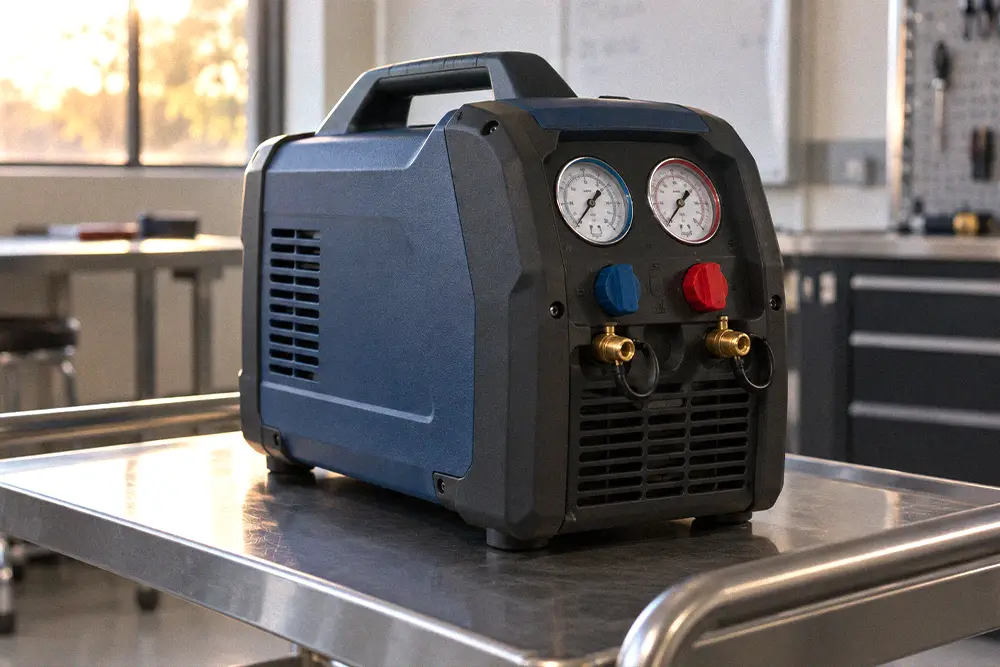
As new HFC supply is reduced, keeping usable refrigerant within the service supply chain becomes increasingly important.
However, recovered and reclaimed refrigerant are not interchangeable descriptions. The EPA’s recovery, recycling, and reclamation definitions distinguish collecting refrigerant from processing it to specified purity requirements and verifying those requirements analytically.
A recovery machine does not automatically turn used refrigerant into certified reclaimed material.
For contractors, practical priorities include keeping recovered refrigerants properly identified, avoiding cross-contamination, and coordinating with an appropriate reclaimer. For equipment owners, the useful question is whether the proposed service material is correctly identified, suitable for the equipment, and supported by appropriate documentation.
Reclamation also does not authorize changing a system to a different refrigerant. Chemical identity and equipment compatibility still matter.
What Should Homeowners and HVAC Contractors Do Now?
Start with the equipment—not a headline or a cylinder color.
Confirm the exact refrigerant
Read the equipment nameplate and review service records. Do not infer refrigerant type solely from installation year, appearance, or what a neighboring system uses.
Identify the actual work
A leak repair, compressor replacement, complete system replacement, and new commercial installation can raise different questions.
Ask the contractor to explain which category applies before using a regulatory deadline to justify the recommendation.
Separate compliance from compatibility
A refrigerant’s lower climate impact does not make it suitable for an existing system.
Never mix refrigerants or substitute a different product simply because the original refrigerant is affected by a phasedown. Use a qualified HVAC professional with the appropriate certification and follow equipment-specific instructions.
Plan around documented needs
For contractors, inventory planning should reflect the installed equipment they actually service, recent usage, and recovery practices.
For homeowners, compare repair and replacement proposals using total scope and equipment condition. A claim that “all refrigerant will soon be unavailable” is not a sound basis for an expensive decision.
Freon Shop’s practical takeaway is straightforward: identify the refrigerant first, then evaluate the rule that applies to the equipment and work being proposed.
Frequently Asked Questions
Is R410A completely banned in the United States?
No. Its HFC ingredients are affected by the phasedown, and restrictions apply to particular new equipment. That is different from a blanket prohibition on servicing existing R410A systems.
Is R32 being phased down even though it is used in newer AC systems?
Yes. R32 is a regulated HFC. Meeting a new-equipment requirement does not exempt its production and import from the allowance framework.
Does the phasedown require every homeowner to replace an air conditioner?
No. The supply phasedown is not a universal retirement order for existing equipment. A replacement decision should consider the actual system, repair requirements, and applicable rules.
Are HFOs and natural refrigerants part of the same HFC allowance program?
Pure HFOs and natural refrigerants such as carbon dioxide, ammonia, and propane are not the regulated HFCs listed under this allowance program. However, HFO-containing blends may include regulated HFCs. Other safety, equipment, and environmental requirements can still apply.
Will refrigerant prices definitely increase?
The phasedown alone cannot establish a particular price forecast. Demand, inventories, production decisions, reclamation, and distribution conditions also matter. Treat guaranteed price predictions cautiously.
Conclusion
The U.S. HFC phasedown affects more than older, high-GWP refrigerants. It also covers regulated HFC ingredients used in some newer refrigerant options.
R22 belongs to a separate ozone-depletion phaseout. New-equipment restrictions are another distinct layer, and neither should be confused with a blanket ban on existing-system service.
For Freon Shop readers, the safest way to interpret any transition claim is to ask three questions: Which refrigerant? Which equipment? Which activity and date? Those details turn a confusing headline into a useful maintenance or replacement decision.