
For most compatible commercial refrigeration retrofits, R449A is generally the better long-term choice than R404A. It delivers similar low- and medium-temperature refrigeration performance with a substantially lower global warming potential.
However, R449A is not automatically the correct refrigerant for every system. R404A may remain appropriate when servicing an existing R404A system that has not been approved or economically justified for conversion. A technician must evaluate the compressor, expansion device, operating temperature, controls, lubricant, discharge temperature, and applicable regulations before deciding.
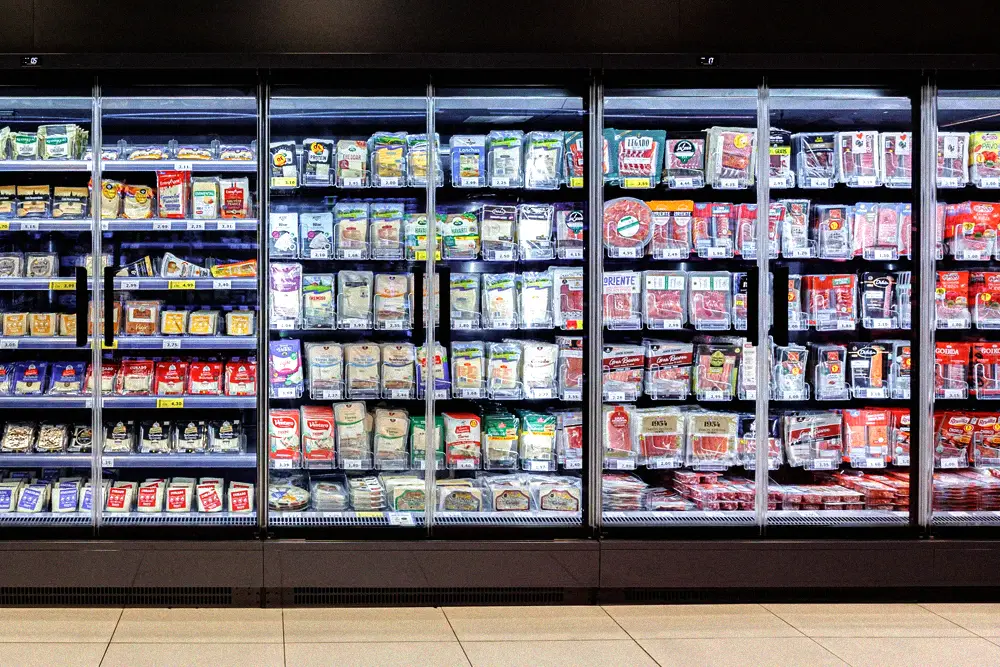
R449A vs R404A at a Glance
R404A became widely used in supermarket racks, walk-in freezers, refrigerated display cases, ice machines, and other low-temperature equipment. It provides dependable refrigeration performance, but its high GWP has made it a major target of the industry transition toward lower-impact alternatives.
R449A is an HFC/HFO blend developed for low- and medium-temperature commercial refrigeration. It is frequently evaluated as an R404A retrofit option because its operating characteristics are close enough for many compatible direct-expansion systems—provided the conversion is performed correctly.
| Comparison | R404A | R449A |
|---|---|---|
| Refrigerant type | HFC blend | HFC/HFO blend |
| AR4 GWP | Approximately 3,922 | Approximately 1,397 |
| Ozone depletion potential | 0 | 0 |
| ASHRAE safety classification | A1 | A1 |
| Temperature glide | Relatively small | Approximately 4 K or 7.2°F |
| Typical role | Servicing compatible legacy equipment | Approved retrofits and compatible equipment |
| Direct drop-in replacement? | Not applicable | No—system conversion and adjustment are required |
Sources: Refrigerant properties are based on Chemours R449A product information and Honeywell R404A technical information. GWP values can differ depending on the IPCC assessment basis used, so values should always be compared on the same basis.
Why R449A Is Often the Better Retrofit Choice
It has a much lower GWP
On the AR4 basis, R449A has a GWP of approximately 1,397 compared with approximately 3,922 for R404A. That does not make R449A a very-low-GWP refrigerant, but it represents a substantial reduction for a compatible system that would otherwise continue operating with R404A.
This difference is especially important for large supermarket racks and commercial systems with significant charge sizes. A leak from a high-charge R404A system can have a considerably greater climate impact than a similar mass release of R449A.
The EPA notes that large retail-food systems are increasingly using HFC/HFO blends such as R448A and R449A instead of relying exclusively on higher-GWP HFC blends. Its overview of advanced retail refrigeration technologies also emphasizes reducing both refrigerant charge and leakage.
It is an A1 refrigerant
Both R404A and R449A are classified as A1, meaning lower toxicity and no flame propagation under the applicable classification tests. This can make R449A a more practical retrofit candidate than a mildly flammable or flammable alternative in systems that were not designed for those safety classes.
A1 classification does not eliminate normal refrigerant hazards. High concentrations can displace oxygen, liquid refrigerant can cause frostbite, and pressurized containers and service equipment require correct handling.
It was developed for commercial refrigeration retrofits
According to the Chemours refrigerant replacement guide, R449A is intended for compatible R404A and R507 refrigeration applications using POE lubricant. The guide also identifies expansion-valve adjustments and possible low-temperature compressor cooling requirements as considerations.
That makes R449A a viable retrofit option—not a refrigerant that should simply be added to an R404A system.
R449A Is Not a Drop-In Replacement
The phrase “drop-in replacement” can give technicians and equipment owners the wrong impression. A proper R404A-to-R449A conversion requires more than recovering one refrigerant and charging another.
The system must be evaluated before conversion, and its post-retrofit operation must be commissioned using R449A data.
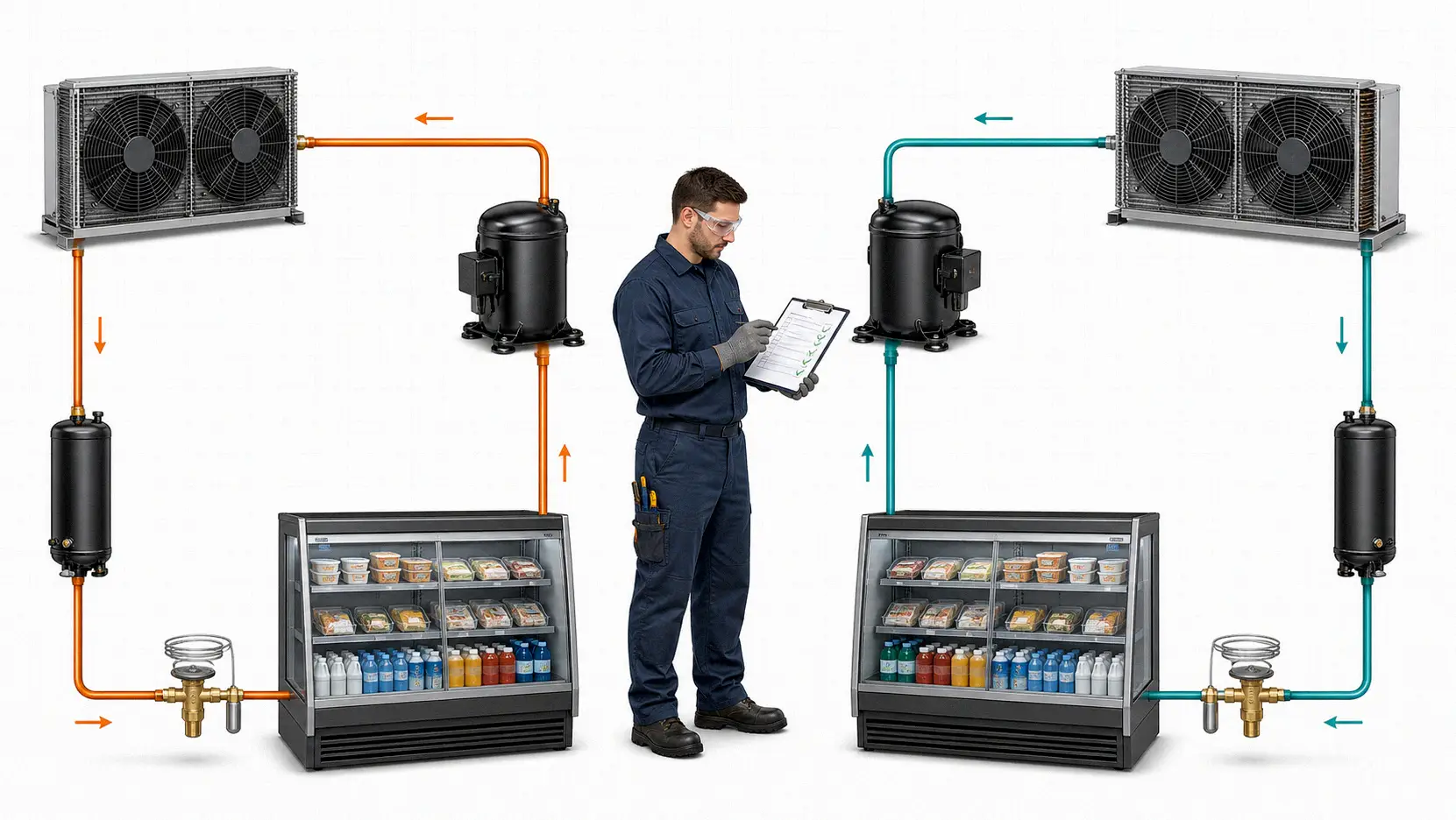
Temperature glide changes service calculations
R449A has a temperature glide of approximately 4 K, or 7.2°F. Technicians must therefore use the correct saturation value when calculating superheat and subcooling:
- Use the dew-point temperature for evaporator superheat.
- Use the bubble-point temperature for liquid subcooling.
Using only a single saturation temperature as if R449A were a near-azeotropic refrigerant can produce incorrect charging or expansion-valve decisions.
Mass flow is different
Manufacturer retrofit guidance indicates that R449A can have a mass-flow rate approximately 20% to 25% lower than R404A. An existing expansion valve may remain within an acceptable operating range, but adjustment—or in some cases a different power element or valve selection—may be needed.
A technician should not assume that the original R404A control setting will produce the correct R449A superheat.
Discharge temperature may increase
R449A can produce a higher compressor discharge temperature, particularly in low-temperature applications. Depending on the compressor and operating envelope, liquid injection, demand cooling, control changes, or another manufacturer-approved measure may be necessary.
Compressor approval must be confirmed before conversion. Similar pressure readings do not prove that a compressor is approved for the refrigerant.
What a Proper R404A-to-R449A Retrofit Involves
The exact procedure must follow the equipment, compressor, control, and refrigerant manufacturers’ instructions. A typical professional workflow includes the following:
| Stage | Required Work | Why It Matters |
|---|---|---|
| 1. Establish baseline operation | Record pressures, temperatures, superheat, subcooling, amperage, box temperature, and existing charge. | Provides a reference for commissioning the converted system. |
| 2. Confirm system approval | Verify compressor, lubricant, seals, controls, valves, and application envelope. | Prevents an unsuitable or unsupported conversion. |
| 3. Recover all R404A | Recover and weigh the existing charge into an approved recovery cylinder. | R404A and R449A must not be mixed. |
| 4. Repair and prepare | Repair leaks, replace the filter-drier, inspect seals, evacuate, and perform required modifications. | A retrofit should not preserve known leaks or contamination. |
| 5. Charge R449A as liquid | Introduce the blend from the cylinder in liquid form using approved charging procedures. | Helps maintain the intended blend composition. |
| 6. Adjust and commission | Set controls, verify superheat and subcooling, check discharge temperature, leak-test, and label the system. | Confirms safe operation under actual load conditions. |
Source: The workflow is summarized from the Chemours R449A retrofit guidelines. Equipment-specific manufacturer instructions take priority.
When R404A Can Still Be the Practical Choice
R404A is not automatically the wrong refrigerant simply because R449A has a lower GWP. There are situations in which continuing to service an R404A system may be reasonable.
The system has not been approved for R449A
If the compressor or another critical component does not have documented R449A approval, maintaining the original refrigerant may be safer than making an unsupported conversion.
The repair is limited and the equipment is near replacement
A full retrofit may not be economical for a system approaching the end of its useful life. Repairing the existing R404A circuit may provide time to plan a complete replacement using equipment designed for a longer-term refrigerant strategy.
The facility cannot accommodate retrofit downtime
A supermarket, restaurant, or cold-storage facility may require careful scheduling, temporary refrigeration, product relocation, or staged rack conversion. Continuing with R404A temporarily can be an operational decision while a properly engineered transition is prepared.
The existing R404A system is performing reliably
An operating legacy system is not automatically required to be converted simply because newer systems face lower GWP limits. Leak history, refrigerant availability, energy performance, component condition, and remaining equipment life should all influence the decision.
How Current EPA Rules Affect the Choice
Refrigerant selection now requires distinguishing among three different activities:
- Servicing or repairing an existing system
- Retrofitting a legacy system
- Installing a new system
These activities do not always have the same requirements.
The EPA’s current guidance states that stores may maintain and repair legacy R404A supermarket systems throughout the equipment’s useful life. The agency also says that the Technology Transitions Rule does not prohibit converting an existing R404A supermarket system to R449A after January 1, 2027. These answers appear in the EPA’s HFC phasedown frequently asked questions.
For new retail-food systems, however, applicable GWP limits depend on the system type, charge size, configuration, and installation date. According to the EPA’s updated HFC restrictions by sector:
- New remote condensing units became subject to an interim 1,400 GWP limit on July 27, 2026.
- New supermarket systems become subject to an interim 1,400 GWP limit on January 1, 2027.
- Beginning January 1, 2032, the limits for those categories generally decrease to 150 or 300, depending on charge size and system configuration.
Because R449A has an AR4 GWP of approximately 1,397, it falls just below the 1,400 interim limit. It does not satisfy a future 150 or 300 GWP limit. Therefore, R449A can be a useful bridge for certain retrofits and currently permitted equipment, but it should not be described as the universal refrigerant for every future commercial system.
Facilities planning new equipment should verify the exact EPA category, effective date, state requirements, SNAP listing, safety standard, and manufacturer approval before finalizing the design.
Which Refrigerant Should You Choose?
| Situation | Likely Direction |
|---|---|
| Compatible R404A system with substantial remaining life | Evaluate a professional R449A retrofit. |
| Minor repair on a reliable legacy R404A system | Continuing with R404A may be practical. |
| System has repeated leaks or failing major components | Compare retrofit cost with full equipment replacement. |
| New system expected to operate beyond 2032 | Evaluate refrigerants and architectures that meet the applicable long-term GWP limit. |
| Unknown compressor or component compatibility | Do not convert until written manufacturer approval is confirmed. |
For technicians sourcing refrigerant for an approved repair or conversion, Freon Shop provides dedicated pages for R449A refrigerant and R404A refrigerant. Confirm the equipment specification and required quantity before ordering.
Frequently Asked Questions
Can R449A be added directly to an R404A system?
No. R404A must be properly recovered before the system is charged with R449A. Mixing them creates an unknown refrigerant composition and makes reliable pressure-temperature calculations, charging, performance verification, and future recovery more difficult.
Is R449A a drop-in replacement for R404A?
No. R449A is better described as a retrofit refrigerant for approved applications. Expansion devices, controls, seals, filter-driers, charging procedures, and compressor discharge temperatures may require attention.
Can the same POE oil be used?
Both refrigerants are commonly associated with POE lubricant in commercial refrigeration, but the technician must confirm the required lubricant type, viscosity, oil condition, and compressor approval. The fact that a system contains POE oil does not by itself approve the conversion.
Does R449A run at the same pressure as R404A?
Their operating pressures can be close enough to make R449A practical in many approved retrofits, but they do not have identical pressure-temperature relationships. Technicians must use an R449A pressure-temperature chart and account for dew and bubble temperatures.
Is R449A better for new commercial refrigeration systems?
Not necessarily. It may fit certain current categories, but new equipment expected to operate for many years should be evaluated against the EPA limits that will apply throughout its planned service life. Systems subject to future 150 or 300 GWP limits will require a different refrigerant strategy.
Who can purchase and work with these refrigerants?
The EPA refrigerant sales restriction generally limits stationary-equipment refrigerant purchases to Section 608-certified technicians, their employers or authorized representatives, and qualifying resellers. The EPA also requires technicians who service equipment in ways that could release refrigerant to hold the appropriate Section 608 certification.
Final Verdict
R449A is usually the stronger choice for an approved retrofit when the goal is to reduce GWP while retaining an existing commercial refrigeration system. It offers a substantial GWP reduction compared with R404A and can provide comparable refrigeration capability in appropriately converted low- and medium-temperature equipment.
R404A remains useful for maintaining compatible legacy systems, especially when a conversion is unsupported, uneconomical, or inconsistent with the facility’s replacement schedule.
The final decision should never be based on refrigerant name or pressure alone. A qualified technician should evaluate system approval, temperature range, compressor envelope, expansion-device capacity, discharge temperature, leak history, equipment life, regulatory category, and total project cost before selecting either refrigerant.