
When an air conditioner runs low on refrigerant, it loses part of its ability to absorb heat from indoor air. The system may blow air that is not cold enough, run almost continuously, struggle with indoor humidity, or develop ice on the evaporator coil and refrigerant lines.
Continuing to operate the system in this condition can increase energy consumption and place the compressor at risk.
Low refrigerant is not something an air conditioner should develop through normal operation. Residential air-conditioning systems circulate refrigerant through a closed circuit. If the charge is low, there is usually a leak, a charging error from a previous installation or repair, or refrigerant loss during service.
Adding more refrigerant without finding the cause is therefore not a complete solution.
What Does “Low Refrigerant” Mean?
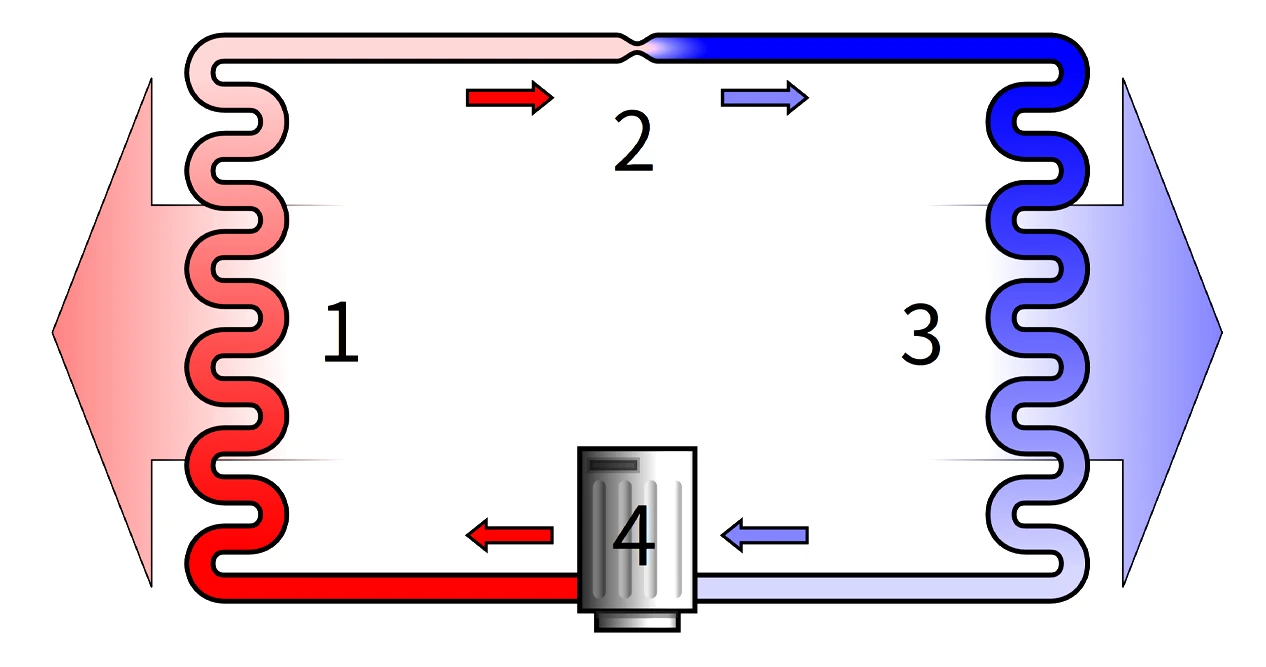
Every air-conditioning system is designed to operate with a particular refrigerant and a specified refrigerant charge. That charge allows the refrigerant to:
- Absorb heat at the indoor evaporator coil
- Carry that heat through the refrigerant lines
- Release the heat through the outdoor condenser
- Return to the evaporator and repeat the cycle
When insufficient refrigerant is circulating, pressures and temperatures inside the system move outside their intended operating range. The evaporator may become colder than it should, while its overall cooling capacity decreases.
That combination sometimes confuses homeowners: a section of the equipment can be cold enough to form ice even though the house is not cooling properly.
The U.S. Department of Energy explains that refrigerant charge affects both air-conditioner capacity and efficiency. Its diagnostic guidance also notes that an undercharged system can produce low suction pressure, low evaporator temperature, ice formation, restricted airflow, and possible compressor damage. See the DOE’s Measure Guideline: Air Conditioner Diagnostics, Maintenance, and Replacement.
What Happens Inside an Undercharged Air Conditioner?
A low refrigerant charge can create a chain reaction rather than one isolated symptom.
1. The evaporator absorbs less heat
The evaporator coil depends on the correct amount of refrigerant moving through it. When the charge is low, parts of the coil may not be used effectively, reducing the system’s ability to remove heat from indoor air.
The supply vents may still produce some cool air, but the temperature difference may be insufficient to cool the home under normal summer conditions.
2. Evaporator pressure falls
A lower refrigerant charge can produce abnormally low pressure on the evaporator side of the system. As pressure falls, the refrigerant’s saturation temperature also falls.
The coil surface can eventually drop below freezing.
3. Moisture freezes on the coil
Warm household air naturally contains moisture. Under normal conditions, some of that moisture condenses on the evaporator coil and drains away as water.
If the coil is below freezing, the moisture can turn into frost or ice instead.
4. Ice restricts airflow
A light frost can grow into a thicker ice layer. That ice blocks air from moving through the evaporator coil, further reducing heat transfer.
The reduced airflow makes the original problem worse: the coil absorbs even less heat, more ice may form, and less conditioned air reaches the rooms.
5. The system runs longer
Because the thermostat setting is not being reached, the air conditioner may operate for unusually long cycles. Longer operation can raise electricity use without producing normal comfort.
6. The compressor faces additional stress
The compressor is designed to operate within a particular range of refrigerant pressures and temperatures. Severe undercharging may interfere with refrigerant flow, cooling, and proper oil return.
Repeated operation under abnormal conditions can shorten compressor life. A compressor failure is generally much more serious than repairing a small, accessible refrigerant leak early.
Common Symptoms of Low AC Refrigerant
No single symptom proves that an air conditioner is undercharged. Restricted airflow, a dirty coil, a failing blower, a metering-device problem, or another mechanical fault can produce similar behavior.
The following warning signs should be treated as reasons for professional diagnosis.
| Symptom | What It May Indicate | Recommended Response |
|---|---|---|
| Air from the vents is not cold enough | The evaporator is not absorbing enough indoor heat | Check the thermostat and filter, then arrange a diagnosis if the problem continues |
| Long or nearly continuous cooling cycles | The system may lack sufficient cooling capacity | Avoid lowering the thermostat repeatedly; have the system inspected |
| Ice on the indoor coil or refrigerant line | Low refrigerant, restricted airflow, or another evaporator problem | Turn off cooling and allow the system to thaw before service |
| Water around the indoor unit | Ice may be melting, or the condensate drain may be blocked | Stop cooling if ice is present and protect the surrounding area from water |
| Higher electricity bills | The system may be running longer to provide less cooling | Compare operating behavior and schedule service if the change is unexplained |
| Hissing or bubbling near refrigerant components | A refrigerant leak may be present | Do not disturb the line or attempt a DIY repair; contact a qualified technician |
| House feels humid despite AC operation | Reduced cooling performance may be affecting moisture removal | Check airflow and request a complete performance evaluation |
Technical context: The Carrier air-conditioner troubleshooting guide identifies inadequate cooling, high utility bills, excessive drainage, and ice on refrigerant lines as possible warning signs associated with a frozen evaporator coil.
The Most Noticeable Warning Signs
Warm or only slightly cool air
Set the thermostat to cooling and compare the air entering the return grille with the air leaving the supply vents. If the system runs but the supply air is not noticeably cooler, there may be a refrigeration, airflow, or compressor problem.
This test cannot confirm low refrigerant, but it can establish that the system is not performing normally.
Ice on the copper line or evaporator
Visible ice is one of the strongest signs that the air conditioner should be turned off and inspected. However, it is not proof of a refrigerant leak.
A clogged filter, closed vents, dirty evaporator, weak blower, or blocked return can also allow the coil to freeze. Trane lists both insufficient airflow and low refrigerant among the possible causes of a frozen evaporator coil.
Water after the system shuts down
A frozen coil can hold a considerable amount of ice. When the air conditioner is turned off, the ice melts and may overwhelm the drain pan or expose an existing drainage problem.
Water around an air handler should be addressed promptly because it can damage ceilings, floors, insulation, and nearby materials.
Hissing, bubbling, or oily residue
A hissing sound may indicate refrigerant escaping through a small opening. Bubbling can occur where refrigerant and oil move through a leak under certain conditions.
Because refrigerant circulates with compressor oil, oily residue around a joint or coil can also be a clue. These signs help a technician decide where to test, but the leak still needs to be confirmed with appropriate diagnostic equipment.
Can You Keep Running an AC That Is Low on Refrigerant?
Continued operation is not recommended when the system is frozen, producing little cooling, making unusual noises, or failing to maintain temperature.
If you see ice:
- Switch the thermostat from Cool to Off.
- Do not scrape, chip, or heat the ice.
- Check whether the air filter is heavily clogged.
- Keep supply and return vents unobstructed.
- Protect the area around the indoor unit from meltwater.
- Arrange professional service before restarting normal cooling.
Running the blower fan without cooling may help air move across a thawing coil, but only if the blower is operating normally and there is no electrical or water-related safety concern.
A frozen system will not permanently correct itself merely because the ice melts. The underlying refrigerant, airflow, drainage, or mechanical problem remains. Carrier similarly advises that a frozen air conditioner requires the cause to be identified.
Why Does an Air Conditioner Become Low on Refrigerant?
A refrigerant leak
Leaks can develop at flare connections, brazed joints, service valves, coils, tubing, or components affected by corrosion or vibration.
Leak size matters. A substantial opening may cause cooling performance to decline quickly. A microscopic leak may take months or even years to become noticeable.
An incorrect original charge
A newly installed system can be undercharged if the required amount was not calculated or measured correctly. Split systems may require a charge adjustment based on refrigerant-line length and manufacturer instructions.
Refrigerant loss during previous service
Refrigerant can also be lost if service ports, valve cores, caps, hoses, or connections are not handled and sealed correctly during maintenance.
Regardless of the cause, refrigerant is not normally “used up” by producing cold air.
What Is the Correct Solution?
The proper repair is more than attaching a cylinder and adding refrigerant.
Step 1: Rule out airflow problems
The technician should inspect the filter, blower, evaporator coil, duct restrictions, return-air path, and vent configuration. This helps distinguish an undercharge from a problem that creates similar symptoms.
Step 2: Measure system performance
A qualified technician can evaluate operating pressures, line temperatures, superheat, subcooling, indoor and outdoor conditions, airflow, and temperature change.
Pressure alone is not enough to diagnose every system.
Step 3: Locate the leak
Depending on the situation, the technician may use an electronic leak detector, approved bubble solution, ultraviolet detection methods, pressure testing, or isolation testing.
Step 4: Repair the cause
Accessible fittings or valves may be repairable. A leaking evaporator or condenser coil may require a more substantial repair or replacement decision.
Step 5: Verify the sealed system
After the repair, the system should be tested according to the equipment manufacturer’s procedures. Required evacuation and dehydration steps help remove air and moisture before charging.
Step 6: Charge with the exact refrigerant and amount
The correct refrigerant must match the equipment nameplate and manufacturer specifications. The final charge is normally established using approved charging procedures and measured quantities—not guesswork.
Carrier’s guidance on an AC refrigerant recharge similarly describes leak repair and charging to manufacturer specifications as essential parts of the process.
Why “Topping It Off” Is Not a Complete Repair
Adding refrigerant may temporarily restore cooling, but it does not close the leak that allowed the original charge to escape.
A repeated top-off approach can lead to:
- Recurring loss of cooling
- Repeated service expense
- Continued operation outside the intended charge range
- Greater risk of coil icing
- Possible compressor damage
- Unnecessary refrigerant emissions
There are limited situations in which a technician may add refrigerant as part of a documented diagnostic or repair procedure. For a leaking system, however, the lasting solution is to locate and correct the leak whenever repair is practical.
Should You Repair or Replace the Air Conditioner?
Low refrigerant alone does not automatically mean the system must be replaced. The better decision depends on:
- The age and general condition of the equipment
- The location and size of the leak
- Whether the leaking component is repairable
- Compressor condition
- Previous repair history
- Parts and refrigerant availability
- Manufacturer warranty coverage
- The expected reliability of the completed repair
A leaking service valve on an otherwise healthy system may justify repair. A severely corroded coil in an older system with other major problems may support replacement.
Ask for a written diagnosis identifying the leak location, proposed repair, required refrigerant, and warranty before deciding.
Refrigerant Safety and EPA Requirements
Homeowners should not connect gauges, open refrigerant lines, add refrigerant, mix refrigerants, or substitute one refrigerant for another.
The U.S. Environmental Protection Agency requires Section 608 technician certification for activities that can reasonably be expected to release refrigerant, including adding or removing refrigerant and attaching or disconnecting gauges and hoses. The current requirements are explained on the EPA’s Section 608 Technician Certification page.
Refrigerants operate under pressure and may cause frostbite, eye injuries, equipment damage, or hazardous decomposition products if handled incorrectly.
The replacement refrigerant must be approved for the specific equipment. Product availability does not establish compatibility.
Frequently Asked Questions
Will an AC still cool if it is low on refrigerant?
It may continue to produce some cooling, especially during mild weather. As the charge becomes more inadequate or outdoor conditions become hotter, the system may run longer and fall progressively farther behind the thermostat setting.
Does low refrigerant always cause ice?
No. Ice formation depends on the degree of undercharge, indoor airflow, humidity, system design, and operating conditions. Some undercharged systems show reduced capacity without obvious external ice.
Can a dirty air filter cause the same symptoms?
Yes. A heavily restricted filter can reduce airflow, freeze the evaporator, increase runtime, and weaken cooling. That is why airflow should be checked before concluding that refrigerant is low.
How often should a home air conditioner be recharged?
A properly installed and sealed system does not need refrigerant recharge as routine scheduled maintenance. If refrigerant must be added, the technician should determine why the charge became low.
Can refrigerant leak sealer solve the problem?
Leak sealers are not a universal repair. Their suitability depends on the equipment, leak, manufacturer guidance, and service company practices. They should not replace proper leak detection and mechanical repair when the leak can be located and corrected.
How quickly can refrigerant leak out?
A large leak may cause rapid performance loss. A very small leak may take months or years to produce noticeable symptoms. The rate cannot be determined reliably from indoor comfort alone.
How do I know which refrigerant my AC uses?
Check the outdoor unit’s data plate and service documentation. Refrigerants such as R-22, R-410A, R-32, and R-454B have different properties and equipment requirements and must not be mixed or casually substituted.
A qualified technician should confirm the exact refrigerant before purchase or service.
Final Takeaway
Low refrigerant reduces an air conditioner’s ability to remove heat and control humidity. It can also lower evaporator pressure, create ice, restrict airflow, increase runtime, and place the compressor under damaging operating conditions.
Turn off cooling if the system is frozen, check basic airflow conditions, and have an EPA-certified technician identify the actual cause. The correct solution is to diagnose the system, repair a confirmed leak when practical, and restore the exact refrigerant charge specified by the manufacturer.
Once a qualified technician has identified the required refrigerant and quantity, eligible purchasers can explore the Freon Shop refrigerant collection. Always verify equipment compatibility before ordering, and never mix or substitute refrigerants.